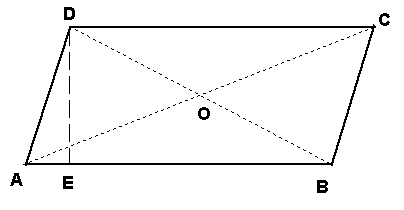
1. The parallelogram
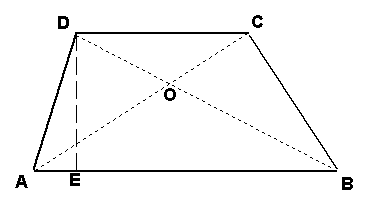
A B C D ( A B ∣ ∣ C D , B C ∣ ∣ A D , D E ⊥ A B ) ; ABCD\,\left( AB||\,CD,BC||\,AD,\,DE\bot AB \right); A B C D ( A B ∣∣ C D , B C ∣∣ A D , D E ⊥ A B ) ;
A C ∩ B D = { O } , O A = O C , O B = O D ; A A B C D = A B ⋅ D E ; A A B C D = A B ⋅ A D ⋅ sin A ; \begin{aligned} & AC\cap BD=\left\{ O \right\},\, \\ & OA=OC,\,\,OB=OD\,;\,{{A}_{ABCD}}=AB\cdot DE;\, \\ & {{A}_{ABCD}}=AB\cdot AD\cdot \sin A; \\ \end{aligned} A C ∩ B D = { O } , O A = O C , O B = O D ; A A B C D = A B ⋅ D E ; A A B C D = A B ⋅ A D ⋅ sin A ;
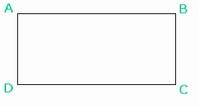
2. The rectangle
A B C D ( A B ∣ ∣ C D , B C ∣ ∣ A D , ∡ A = 90 0 ) ABCD\,\left( AB||CD,BC||AD,\measuredangle \,A={{90}^{0}} \right) A B C D ( A B ∣∣ C D , B C ∣∣ A D , ∡ A = 90 0 ) ;
A C = B D ; A A B C D = A B ⋅ A D ; \begin{aligned} & AC=BD; \\ & {{A}_{ABCD}}=AB\cdot AD; \\ \end{aligned} A C = B D ; A A B C D = A B ⋅ A D ;
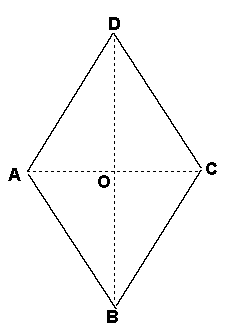
3. The rhombus A B C D ( A B ∣ ∣ C D , B C ∣ ∣ A D , A B = B C ) : A C = d 1 , ABCD\,\left( AB||CD,\,BC||AD,\,AB=BC \right)\,:\,AC={{d}_{1}}, A B C D ( A B ∣∣ C D , B C ∣∣ A D , A B = B C ) : A C = d 1 ,
B D = d 2 , A B = A D = a ; A C ⊥ B D ; A A B C D = d 1 ⋅ d 2 2 ; \begin{aligned} & BD={{d}_{2}},\,AB=AD=a;\,AC\bot BD; \\ & {{A}_{ABCD}}=\frac{{{d}_{1}}\cdot {{d}_{2}}}{2}\,; \\ \end{aligned} B D = d 2 , A B = A D = a ; A C ⊥ B D ; A A B C D = 2 d 1 ⋅ d 2 ;
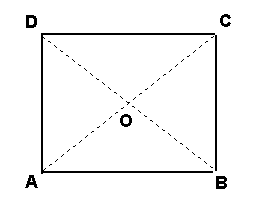
4. The square A B C D ( A B ∣ ∣ C D , B C ∣ ∣ A D , A B = B C , ∡ A = 90 0 , A B = a , A C = d ) ABCD\,(AB||CD,BC||AD,AB=BC,\measuredangle \,A={{90}^{0}},AB=a,AC=d) A B C D ( A B ∣∣ C D , B C ∣∣ A D , A B = B C , ∡ A = 90 0 , A B = a , A C = d )
A C = B D , A C ⊥ B D , d = a 2 ; A A B C D = a 2 ; AC=BD,\text{ }AC\bot BD,\text{ }d=a\sqrt{2};\text{ }{{A}_{ABCD}}={{a}^{2}}; A C = B D , A C ⊥ B D , d = a 2 ; A A B C D = a 2 ;
5. The trapezium
A B C D ( A B ∣ ∣ C D , A B = B , D C = b , D E = h , M N − l i n i e m i j l o c i e ) : ABCD\left( AB||CD,AB=B,DC=b,DE=h,MN-linie\,\,\,\,mijlocie \right): A B C D ( A B ∣∣ C D , A B = B , D C = b , D E = h , M N − l ini e mij l oc i e ) :
M N = B + b 2 ; A A B C D = ( B + b ) ⋅ h 2 = M N ⋅ h ; MN=\frac{B+b}{2};\,\text{ }{{A}_{ABCD}}=\frac{\left( B+b \right)\cdot h}{2}=MN\cdot h; M N = 2 B + b ; A A B C D = 2 ( B + b ) ⋅ h = M N ⋅ h ;
Polygons inscribed in a circle
1. The cyclic quadrilateral
∡ B A D + ∡ B C D = 180 0 ; ∡ B A C ≡ ∡ B D C ; \begin{aligned} & \measuredangle \,BAD+\measuredangle \,BCD={{180}^{0}}; \\ & \measuredangle \,BAC\,\equiv \,\measuredangle \,BDC; \\ \end{aligned} ∡ B A D + ∡ B C D = 180 0 ; ∡ B A C ≡ ∡ B D C ;
Ptolemy's theorem:
A B ⋅ D C + A D ⋅ B C = A C ⋅ B D ; AB\cdot DC+AD\cdot BC=AC\cdot BD; A B ⋅ D C + A D ⋅ B C = A C ⋅ B D ;
A A B C D = 1 2 A C ⋅ B D ⋅ sin α {{A}_{ABCD}}=\frac{1}{2}AC\cdot BD\cdot \sin \,\alpha A A B C D = 2 1 A C ⋅ B D ⋅ sin α
2. Regular polygons inscribed in a circle of radius R
The equilateral triangle: l 3 = R 3 , a 3 = R 2 , S 3 = 3 3 R 2 4 ; {{l}_{3}}=R\sqrt{3},{{a}_{3}}=\frac{R}{2},{{S}_{3}}=\frac{3\sqrt{3}{{R}^{2}}}{4}; l 3 = R 3 , a 3 = 2 R , S 3 = 4 3 3 R 2 ;
The square: l 4 = R 2 , a 4 = R 2 2 , S 4 = 2 R 2 ; {{l}_{4}}=R\sqrt{2}, {{a}_{4}}=\frac{R\sqrt{2}}{2}, {{S}_{4}}=2{{R}^{2}}; l 4 = R 2 , a 4 = 2 R 2 , S 4 = 2 R 2 ;
The regular hexagon: l 6 = R , a 6 = R 3 2 , S 6 = 3 3 R 2 2 ; {{l}_{6}}=R,{{a}_{6}}=\frac{R\sqrt{3}}{2},{{S}_{6}}=\frac{3\sqrt{3}{{R}^{2}}}{2}; l 6 = R , a 6 = 2 R 3 , S 6 = 2 3 3 R 2 ;
The regular polygon with n sides: l n = 2 R sin π n , a n = R cos π n ; {{l}_{n}}=2R\sin \frac{\pi }{n},{{a}_{n}}=R\cos \frac{\pi }{n}; l n = 2 R sin n π , a n = R cos n π ;
S = n 2 R 2 sin 2 π n = p ⋅ a n S=\frac{n}{2}{{R}^{2}}\sin \frac{2\pi }{n}=p\cdot {{a}_{n}} S = 2 n R 2 sin n 2 π = p ⋅ a n p = n ⋅ l n 2 p=\frac{n\cdot {{l}_{n}}}{2} p = 2 n ⋅ l n
The circle
Lengths and areas: l c e r c = 2 π R ; A c e r c = π R 2 ; {{l}_{cerc}}=2\pi R;\text{ }{{A}_{cerc}}=\pi {{R}^{2}}; l cer c = 2 π R ; A cer c = π R 2 ;
l a r c A B = π R α 180 , {{l}_{arcAB}}=\frac{\pi R\alpha }{180}, l a r c A B = 180 π R α ,
α \alpha α
A sec t o r A B = π R 2 α 360 ; {{A}_{\sec torAB}}=\frac{\pi {{R}^{2}}\alpha }{360}; A s e c t or A B = 360 π R 2 α ;
μ ( ∡ A O B ) = α ⋅ π 180 \mu \left( \measuredangle AOB \right)=\frac{\alpha \cdot \pi }{180} μ ( ∡ A O B ) = 180 α ⋅ π μ \mu μ
Angle with vertex inside the circle:
m ( ∡ A O B ) = m ( A B ⌢ ) : m\left( \measuredangle AOB \right)=m\left( \overset\frown{AB} \right): m ( ∡ A O B ) = m ( A B ⌢ ) :
m ( ∡ A M B ) = m ( A B ⌢ ) + m ( C D ⌢ ) 2 ; m\left( \measuredangle AMB \right)=\frac{m\left( \overset\frown{AB} \right)+m\left( \overset\frown{CD} \right)}{2}; m ( ∡ A M B ) = 2 m ( A B ⌢ ) + m ( C D ⌢ ) ;
Angle with vertex on the circle ( O M ⊥ M T ) ; \left( OM\bot MT \right); ( O M ⊥ M T ) ;
m ( ∡ A O B ) = m ( A B ⌢ ) 2 ; m\left( \measuredangle AOB \right)=\frac{m\left( \overset\frown{AB} \right)}{2}; m ( ∡ A O B ) = 2 m ( A B ⌢ ) ;
m ( ∡ A M T ) = m ( A M ⌢ ) 2 ; m\left( \measuredangle AMT \right)=\frac{m\left( \overset\frown{AM} \right)}{2}; m ( ∡ A M T ) = 2 m ( A M ⌢ ) ;
Angle with vertex outside the circle ( O T ⊥ M T ) : \left( OT\bot MT \right): ( O T ⊥ M T ) :
m ( ∡ A M B ) = m ( A M ⌢ ) − m ( C D ⌢ ) 2 ; m\left( \measuredangle AMB \right)=\frac{m\left( \overset\frown{AM} \right)-m\left( \overset\frown{CD} \right)}{2}; m ( ∡ A M B ) = 2 m ( A M ⌢ ) − m ( C D ⌢ ) ;
m ( ∡ B M T ) = m ( B T ⌢ ) − m ( D T ⌢ ) 2 ; m\left( \measuredangle BMT \right)=\frac{m\left( \overset\frown{BT} \right)-m\left( \overset\frown{DT} \right)}{2}; m ( ∡ B M T ) = 2 m ( B T ⌢ ) − m ( D T ⌢ ) ;
The power of a point with respect to a circle ( O T ⊥ M T ) : \left( OT\bot MT \right): ( O T ⊥ M T ) :
p ( M ) = M A ⋅ M B = O M 2 − r 2 = M T 2 ; p\left( M \right)=MA\cdot MB=O{{M}^{2}}-{{r}^{2}}=M{{T}^{2}}; p ( M ) = M A ⋅ M B = O M 2 − r 2 = M T 2 ;
P ( N ) = N A ⋅ N B = r 2 − O N 2 ; P\left( N \right)=NA\cdot NB={{r}^{2}}-O{{N}^{2}}; P ( N ) = N A ⋅ N B = r 2 − O N 2 ;
Circular sector
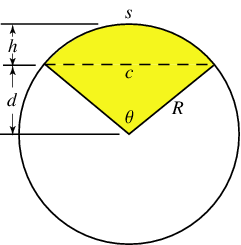
A circular sector is a portion of a disc of angle θ < π \theta <\pi θ < π
R = R= R = s = s= s = h = h= h = d = d= d = A = A= A =
R = h + d R=h+d R = h + d s = R ⋅ θ s=R\cdot \theta s = R ⋅ θ
d = R ⋅ cos ( θ 2 ) = 1 2 4 R 2 − c 2 d=R\cdot \cos \left( \frac{\theta }{2} \right)=\frac{1}{2}\sqrt{4{{R}^{2}}-{{c}^{2}}} d = R ⋅ cos ( 2 θ ) = 2 1 4 R 2 − c 2 c = R ⋅ sin ( θ 2 ) = 2 h ( 2 R − h ) c=R\cdot \sin \left( \frac{\theta }{2} \right)=2\sqrt{h(2R-h)} c = R ⋅ sin ( 2 θ ) = 2 h ( 2 R − h )
θ = s R = 2 arccos ( d R ) \theta =\frac{s}{R}=2\arccos \left( \frac{d}{R} \right) θ = R s = 2 arccos ( R d ) A = 1 2 R ⋅ s = 1 2 R 2 ⋅ θ A=\frac{1}{2}R\cdot s=\frac{1}{2}{{R}^{2}}\cdot \theta A = 2 1 R ⋅ s = 2 1 R 2 ⋅ θ
Further plane geometry
The orthic triangle
A cevian
Ceva's theorem :M B M C ⋅ N C N A ⋅ P A P B = 1 ; \frac{MB}{MC}\cdot \frac{NC}{NA}\cdot \frac{PA}{PB}=1; M C M B ⋅ N A N C ⋅ P B P A = 1 ;
Menelaus' theorem
M B M C ⋅ N C N A ⋅ P A P B = 1 ; \frac{MB}{MC}\cdot \frac{NC}{NA}\cdot \frac{PA}{PB}=1; M C M B ⋅ N A N C ⋅ P B P A = 1 ;
Euler's line
The Simson line
The excircle
The Euler circle
Polyhedra
I The prism
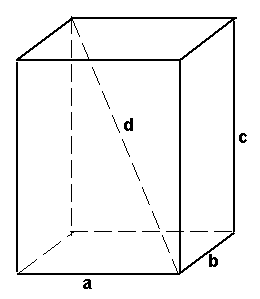
1. The rectangular cuboid:
A l a t = 2 ( a + b ) ⋅ c ; {{A}_{lat}}=2\left( a+b \right)\cdot c; A l a t = 2 ( a + b ) ⋅ c ;
A t o t = 2 ( a b + a c + b c ) ; {{A}_{tot}}=2\left( ab+ac+bc \right); A t o t = 2 ( ab + a c + b c ) ;
V = a b c ; V=abc; V = ab c ;
d 2 = a 2 + b 2 + c 2 ; {{d}^{2}}={{a}^{2}}+{{b}^{2}}+{{c}^{2}}; d 2 = a 2 + b 2 + c 2 ;
2. The cube (of edge a = b = c a=b=c a = b = c ):
A = 6 a 2 ; A=6{{a}^{2}}; A = 6 a 2 ;
V = a 3 ; V={{a}^{3}}; V = a 3 ;
d = a 3 ; d=a\sqrt{3;} d = a 3 ;
3. The parallelepiped:
B O ⊥ ( A B C ) , B ′ O = h ; BO\bot \left( ABC \right),B'O=h; B O ⊥ ( A B C ) , B ′ O = h ;
V = A A B C D ⋅ h ; V={{A}_{ABCD}}\cdot h; V = A A B C D ⋅ h ;
4. The prism (right or oblique, of height h ):
V = A b a z e i ⋅ h ; V={{A}_{bazei}}\cdot h; V = A ba z e i ⋅ h ;
5. The regular triangular prism ( A B = a , Δ A B C = e c h i l a t e r a l ) : \left( AB=a,\Delta ABC=echilateral \right): ( A B = a , Δ A B C = ec hi l a t er a l ) :
A l a t = 3 a ⋅ h ; A t o t = 3 a ⋅ h + a 2 3 2 ; {{A}_{lat}}=3a\cdot h\,;{{A}_{tot}}=3a\cdot h+\frac{{{a}^{2}}\sqrt{3}}{2}; A l a t = 3 a ⋅ h ; A t o t = 3 a ⋅ h + 2 a 2 3 ;
V = a 2 3 4 ⋅ h ; V=\frac{{{a}^{2}}\sqrt{3}}{4}\cdot h\,; V = 4 a 2 3 ⋅ h ;
II The pyramid
1. The regular tetrahedron (all edges congruent , A O ⊥ ( B C D ) AO\bot \left( BCD \right) A O ⊥ ( B C D ) ,
A M ⊥ D C AM\bot DC A M ⊥ D C ):
h = a 6 3 , A M = a 3 2 ; h=\frac{a\sqrt{6}}{3},AM=\frac{a\sqrt{3}}{2}; h = 3 a 6 , A M = 2 a 3 ;
sin A B ^ O = 6 3 , \sin A\hat{B}O=\frac{\sqrt{6}}{3}, sin A B ^ O = 3 6 ,
sin A M ^ O = 2 2 3 ; \sin A\hat{M}O=\frac{2\sqrt{2}}{3}; sin A M ^ O = 3 2 2 ;
A = a 2 3 ; V = a 3 2 12 ; A={{a}^{2}}\sqrt{3};V=\frac{{{a}^{3}}\sqrt{2}}{12}; A = a 2 3 ; V = 12 a 3 2 ;
2. The trirectangular tetrahedron ( O A ⊥ O B ⊥ O C ⊥ O A , OA\bot OB\bot OC\bot OA, O A ⊥ O B ⊥ O C ⊥ O A , O A = O B = O C = a OA=OB=OC=a O A = O B = O C = a , C M ⊥ A B CM\bot AB C M ⊥ A B ):
ΔABC = equilateral,
O M = a 2 2 , C M = a 6 2 , OM=\frac{a\sqrt{2}}{2},CM=\frac{a\sqrt{6}}{2}, O M = 2 a 2 , C M = 2 a 6 ,
A B = a 2 ; A A B C = a 2 3 2 ; AB=a\sqrt{2};{{A}_{ABC}}=\frac{{{a}^{2}}\sqrt{3}}{2}; A B = a 2 ; A A B C = 2 a 2 3 ;
A t o t = 3 a 2 2 + a 2 3 2 ; Atot=\frac{3{{a}^{2}}}{2}+\frac{{{a}^{2}}\sqrt{3}}{2}; A t o t = 2 3 a 2 + 2 a 2 3 ;
V = a 3 6 V=\frac{{{a}^{3}}}{6} V = 6 a 3
3. The regular triangular pyramid ( A B = A C = B C = a AB=AC=BC=a A B = A C = B C = a , V A = V B = V C VA=VB=VC V A = V B = V C , V M ⊥ B C VM\bot BC V M ⊥ B C ,
V M − a p o t e m a VM-apotema V M − a p o t e ma ):
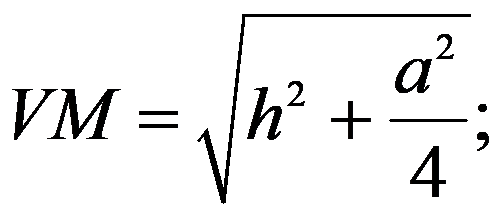
V M = h 2 + a 2 12 ; VM=\sqrt{{{h}^{2}}+\frac{{{a}^{2}}}{12}}; V M = h 2 + 12 a 2 ;
A l a t = 3 a ⋅ V M 2 ; {{A}_{lat}}=\frac{3a\cdot VM}{2}; A l a t = 2 3 a ⋅ V M ;
A t o t = a 2 3 4 + 3 a ⋅ V M 2 ; {{A}_{tot}}=\frac{{{a}^{2}}\sqrt{3}}{4}+\frac{3a\cdot VM}{2}; A t o t = 4 a 2 3 + 2 3 a ⋅ V M ;
V = a 2 3 4 ⋅ h 3 ; V=\frac{{{a}^{2}}\sqrt{3}}{4}\cdot \frac{h}{3}; V = 4 a 2 3 ⋅ 3 h ;
4. The regular square pyramid ( A B C D ABCD A B C D – a square of side a , V A = V B = V C = V D VA=VB=VC=VD V A = V B = V C = V D V M ⊥ B C VM\bot BC V M ⊥ B C ):
A l a t = 2 a ⋅ V M ; {{A}_{lat}}=2a\cdot VM; A l a t = 2 a ⋅ V M ;
A t o t = a 2 + 2 a ⋅ V M ; {{A}_{tot}}={{a}^{2}}+2a\cdot VM; A t o t = a 2 + 2 a ⋅ V M ;
V = a 2 ⋅ h 3 ; V=\frac{{{a}^{2}}\cdot h}{3}; V = 3 a 2 ⋅ h ;
5. The regular hexagonal pyramid (A B C D E F ABCDEF A B C D E F V A = V B = V C = V D = V E = V F = a VA=VB=VC=VD=VE=VF=a V A = V B = V C = V D = V E = V F = a V M ⊥ B C VM\bot BC V M ⊥ B C
V M = h 2 + 3 a 2 4 ; VM=\sqrt{{{h}^{2}}+\frac{3{{a}^{2}}}{4}}; V M = h 2 + 4 3 a 2 ;
A t o t = 3 a ⋅ V M ; {{A}_{tot}}=3a\cdot VM; A t o t = 3 a ⋅ V M ;
A t o t = 3 a 2 3 2 + 3 a ⋅ V M ; {{A}_{tot}}=\frac{3{{a}^{2}}\sqrt{3}}{2}+3a\cdot VM; A t o t = 2 3 a 2 3 + 3 a ⋅ V M ;
V = a 2 3 ⋅ h 2 ; V=\frac{{{a}^{2}}\sqrt{3}\cdot h}{2}; V = 2 a 2 3 ⋅ h ;
6. The regular pyramid (the foot of the altitude coincides with the
circumcentre of the base):
A l a t = P b a z e i ⋅ a p o t e m a 2 ; {{A}_{lat}}=\frac{{{P}_{bazei}}\cdot apotema}{2}; A l a t = 2 P ba z e i ⋅ a p o t e ma ;
A t o t = A b a z e i + A l a t ; V = A b a z e i ⋅ h 3 ; {{A}_{tot}}={{A}_{bazei}}+{{A}_{lat}}\,;\,V=\frac{{{A}_{bazei}}\cdot h}{3}; A t o t = A ba z e i + A l a t ; V = 3 A ba z e i ⋅ h ;
7. The pyramid (of height h )
A t o t = A b a z e i + A l a t ; V = A b a z e i ⋅ h 3 ; {{A}_{tot}}={{A}_{bazei}}+{{A}_{lat}}\,;\,V=\frac{{{A}_{bazei}}\cdot h}{3}; A t o t = A ba z e i + A l a t ; V = 3 A ba z e i ⋅ h ;
III The frustum of a pyramid (B – area of the larger base, b – area of
the smaller base,
h – height):
1. The frustum of a general pyramid:
V = h 3 ( B + b + B ⋅ b ) V=\frac{h}{3}\left( B+b+\sqrt{B\cdot b} \right) V = 3 h ( B + b + B ⋅ b )
2. The frustum of a regular pyramid (P – perimeter of the larger base, p
– perimeter of the smaller base, ap – slant height):
A l a t = ( P + p ) ⋅ a p 2 ; {{A}_{lat}}=\frac{\left( P+p \right)\cdot {{a}_{p}}}{2}; A l a t = 2 ( P + p ) ⋅ a p ;
A t o t = B + b + ( P + p ) ⋅ a p 2 ; {{A}_{tot}}=B+b+\frac{\left( P+p \right)\cdot {{a}_{p}}}{2}; A t o t = B + b + 2 ( P + p ) ⋅ a p ;
V = h 3 ( B + b + B ⋅ b ) ; V=\frac{h}{3}\left( B+b+\sqrt{B\cdot b} \right); V = 3 h ( B + b + B ⋅ b ) ;
IV Regular polyhedra
Euler's relation: v − m + f = 2 v-m+f=2 v − m + f = 2
(v – number of vertices, m – number of edges, f – number of faces);
The types of regular polyhedra:
the regular tetrahedron: f = 4 , v = 4 , m = 6 ; f=4,v=4,m=6; f = 4 , v = 4 , m = 6 ;
the cube (regular hexahedron): f = 6 , v = 8 , m = 12 ; f=6,v=8,m=12; f = 6 , v = 8 , m = 12 ;
the regular octahedron: f = 8 , v = 6 , m = 12 ; f=8,v=6,m=12; f = 8 , v = 6 , m = 12 ;
the regular dodecahedron: f = 12 , v = 20 , m = 30 ; f=12,v=20,m=30; f = 12 , v = 20 , m = 30 ;
the regular icosahedron: f = 20 , v = 12 , m = 30 ; f=20,v=12,m=30; f = 20 , v = 12 , m = 30 ;
Solids of revolution
Notation: R – radius, G – slant height, h – height
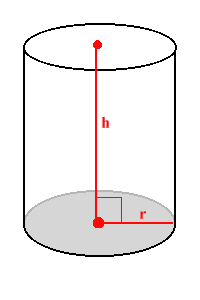
1) The right circular cylinder (h = G h=G h = G
A l a t = 2 π R ⋅ G ; {{A}_{lat}}=2\pi R\cdot G; A l a t = 2 π R ⋅ G ;
A t o t = 2 π R ⋅ ( R + G ) ; {{A}_{tot}}=2\pi R\cdot \left( R+G \right); A t o t = 2 π R ⋅ ( R + G ) ;
V = π R 2 ⋅ h ; V=\pi {{R}^{2}}\cdot h; V = π R 2 ⋅ h ;
2) The right circular cone
G 2 = h 2 + R 2 ; A l a t = π R ⋅ G ; {{G}^{2}}={{h}^{2}}+{{R}^{2}};{{A}_{lat}}=\pi R\cdot G; G 2 = h 2 + R 2 ; A l a t = π R ⋅ G ;
A t o t = π R ⋅ ( R + G ) ; {{A}_{tot}}=\pi R\cdot \left( R+G \right); A t o t = π R ⋅ ( R + G ) ;
V = π R 2 ⋅ h 3 ; V=\frac{\pi {{R}^{2}}\cdot h}{3}; V = 3 π R 2 ⋅ h ;
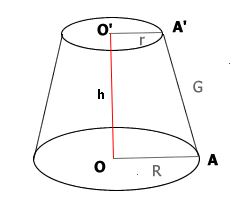
3) The frustum of a cone (r – radius of the smaller base):
G 2 = h 2 + ( R − r ) 2 ; {{G}^{2}}={{h}^{2}}+{{\left( R-r \right)}^{2}}; G 2 = h 2 + ( R − r ) 2 ;
A l a t = π G ⋅ ( R + r ) ; {{A}_{lat}}=\pi G\cdot \left( R+r \right); A l a t = π G ⋅ ( R + r ) ;
A t o t = π G ⋅ ( R + r ) + π ( R 2 + r 2 ) ; {{A}_{tot}}=\pi G\cdot \left( R+r \right)+\pi \left( {{R}^{2}}+{{r}^{2}} \right); A t o t = π G ⋅ ( R + r ) + π ( R 2 + r 2 ) ;
V = π h 3 ( R 2 + r 2 + R ⋅ r ) ; V=\frac{\pi h}{3}\left( {{R}^{2}}+{{r}^{2}}+R\cdot r \right); V = 3 π h ( R 2 + r 2 + R ⋅ r ) ;
4) The sphere:
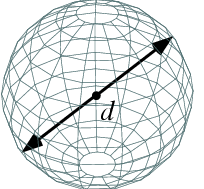
A = 4 π R 2 ; V = 4 π R 3 3 ; A=4\pi {{R}^{2}};V=\frac{4\pi {{R}^{3}}}{3}; A = 4 π R 2 ; V = 3 4 π R 3 ;
A c a l o t e i s f e r e i = 2 π R h 1 ; {{A}_{calotei\,\,sferei}}=2\pi R{{h}_{1}}; A c a l o t e i s f er e i = 2 π R h 1 ;
A z o n e i = 2 π R h 2 ; {{A}_{zonei}}=2\pi R{{h}_{2}}; A z o n e i = 2 π R h 2 ;