The following notations for derivatives are used: 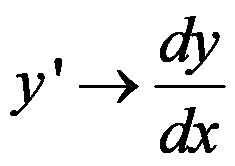 and y′′→dx2d2y, that is
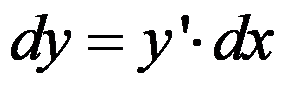 .
.
Definition. A differential equation is a relation between an independent
variable x, the unknown function 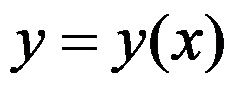 and its derivatives y′,y′′,y′′′,...,y(n), of the form
If the unknown function y is a function of a single variable x, the
differential equation is called ordinary.
Definition. A solution of a differential equation on an interval (a,b)
is a function y=φ(x) defined on that interval together with its derivatives, and
for which substituting y=φ(x) into the differential equation turns it into an
identity in x on (a,b).
To determine all the functions which are solutions of a differential equation is
to solve that differential equation.
A separable differential equation has the form: 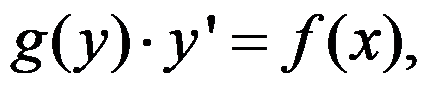 where F:I→R and
g:J→R are two continuous functions. The equation is equivalent to g(y)dy=f(x)dx.
Integrating, we obtain (G∘y)(x)=F(x)+c and y(x)=G−1(F(x)+c), where G is an antiderivative of g, F
is an antiderivative of f, and c∈R.
where F:I→R and
g:J→R are two continuous functions. The equation is equivalent to g(y)dy=f(x)dx.
Integrating, we obtain (G∘y)(x)=F(x)+c and y(x)=G−1(F(x)+c), where G is an antiderivative of g, F
is an antiderivative of f, and c∈R.
A first-order linear differential equation has the form: y′=p(x)∗y+q(x), where p,q:I→R are
continuous functions. The solution of this equation is a differentiable function
φ:I→R satisfying: φ′(x)=p(x)⋅φ(x)+q(x),∀x∈I.
First-order differential equations:  , where p, t are
continuous functions on an interval (a,b).
, where p, t are
continuous functions on an interval (a,b).
Every solution of the first-order ordinary equation is the sum of a particular
solution 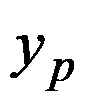 of that equation and the general solution of the equation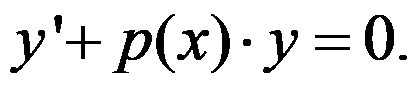
is determined for 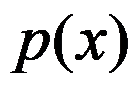 constant and for a particular form of
 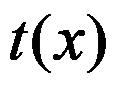 , as
shown in the table below.
, as
shown in the table below.
| | |
| Form of t(x) | Form of the particular solution 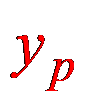 |
| Polynomial | Polynomial of the same degree |
| aerx | αerx |
| ae−rx | αxe−rx |
| acos(rx)+bsin(rx) |
|
| Polynomial | Polynomial of the same degree |
| aerx | αerx |
| ae−rx | αxe−rx |
| acos(rx)+bsin(rx) |  |
|
Solving the homogeneous equation:y′+p(x)⋅y=0
The homogeneous equation y′+p(x)⋅y=0, p:I→R has the solution φ:I→R, φ(x)=k⋅e−x0∫xp(t)dt,
∀x∈I.
The second-order differential equation has the form F(x,y,y′,y′′)=0.
Equations of the form ay′′+by′+cy=h(x) are called second-order differential equations
with constant coefficients.
The second-order linear homogeneous differential equation
The equation 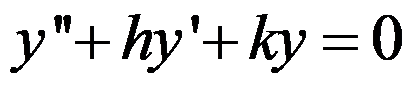 with h2−4k>0,x0y0,y′0∈R has at least one solution f:R→R of the form
f(x)=a⋅y1(x)+b⋅y2(x). The solutions of the characteristic equation, r2+hr+k=0 are r1,r2, and
a and b are real numbers determined from the conditions
with h2−4k>0,x0y0,y′0∈R has at least one solution f:R→R of the form
f(x)=a⋅y1(x)+b⋅y2(x). The solutions of the characteristic equation, r2+hr+k=0 are r1,r2, and
a and b are real numbers determined from the conditions 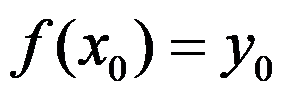 and f′(x0)=y′0.
We have the following cases:
| Δ | solutions of the equation r2+hr+k=0 | solution of the equation y′′+hy′+ky=0 |
|---|
| h2−4k>0h2−4k=0h2−4k<0 | r1,r2,reale,distincter1=r2r1=r2∈C\R,r1=α+iβ | f(x)=aer1x+ber2xf(x)=(ax+b)er1xf(x)=eαx(acos(βx)+bsin(βx)) |
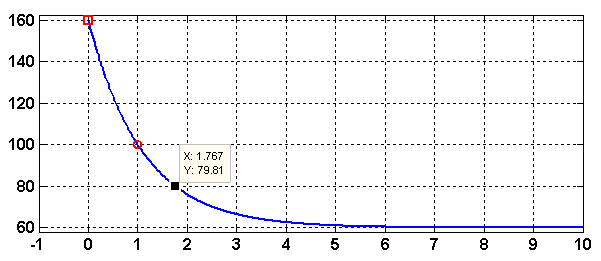
Graphical representation of the solutions of differential equations
- A body heated to 160∘C is immersed in a medium held at a constant
temperature of
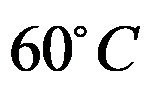 . Within one minute the temperature of the body falls
to
. Within one minute the temperature of the body falls
to 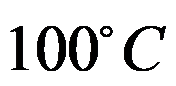 . Let
. Let 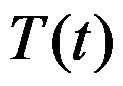 be the temperature of the body at time t and T0
the constant temperature of the medium. Then satisfies the
differential equation: T′(t)=k⋅(60−T(t)), that is T′(t)=−k⋅T(t)+60⋅k, which has the analytic
solution:
be the temperature of the body at time t and T0
the constant temperature of the medium. Then satisfies the
differential equation: T′(t)=k⋅(60−T(t)), that is T′(t)=−k⋅T(t)+60⋅k, which has the analytic
solution: 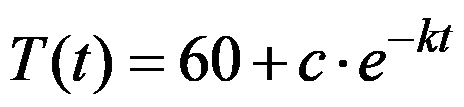 . From the initial conditions
  and
and  .
.
From these conditions we obtain: c=100,k=ln(25). Therefore T(t)=60+100⋅e−tln(25).