Applications of the definite integral
- The area under a graph Γf, f:[a,b]→R+,f continu a˘
Γf=a∫b∣f(x)∣dx
The area between the graphs of two continuous functions f,g:[a,b]→R is:
Γf,g=k=1∑n[f(a+knb−a)−g(a+knb−a)]⋅nb−a
Γf,g=a∫b∣f(x)−g(x)∣dx
The region between the two graphs is the set of points:
Γ={(x,y)∈R2∣a≤x≤b i g(x)≤y≤f(x)}
The area of the region lying between the graphs of the functions
f(x)=x and g(x)=x2
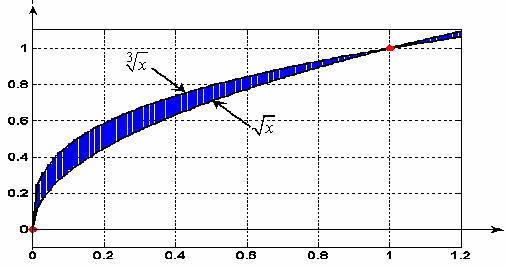
The area of the region lying between the graphs of the functions
f(x)=x2 and g(x)=x3
|:--:|
| sin(x) |
| The region enclosed between the graphs of the functions sin(x) and cos(x) |
|:--:|
|
| The region enclosed between the graphs of the functions and 3x |
- Arc length of a graph
Let f:[a,b]→R be a differentiable function with continuous derivative. The length
of the graph of f is:
l=∫ab1+(f′(x))2dx
- Area of a surface of revolution
Let f:[a,b]→R be a continuous function. The set of points in space:
S={(x,y,z)∈R3∣y2+z2=f(x),x∈[a,b]}
is called the surface of revolution determined by the function f about
the Ox axis.
Let f:[a,b]→R be a differentiable function with continuous derivative. The surface
of revolution determined by f has area:
A(f)=2π∫abf(x)⋅1+(f′(x))2dx
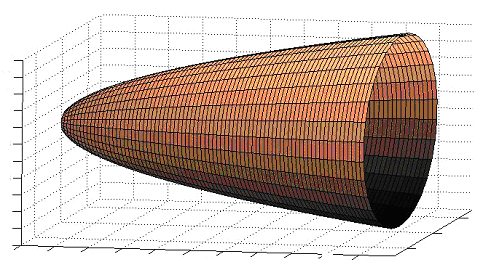
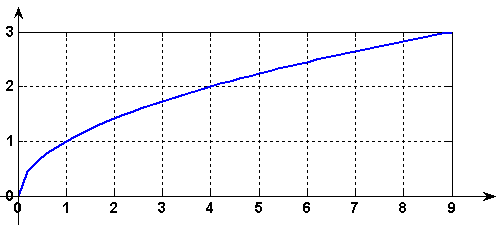
The surface of revolution of the function x on the interval [0,9]
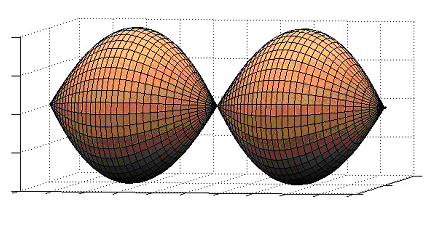
The surface of revolution of the function cos(x) on the interval [0,2π]
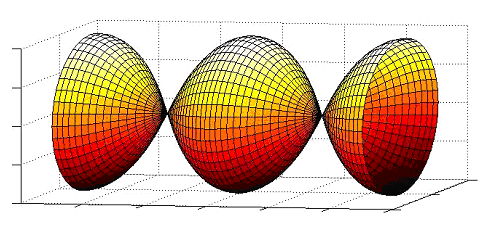
The surface of revolution of the function sin(x) on the interval [0,2π]
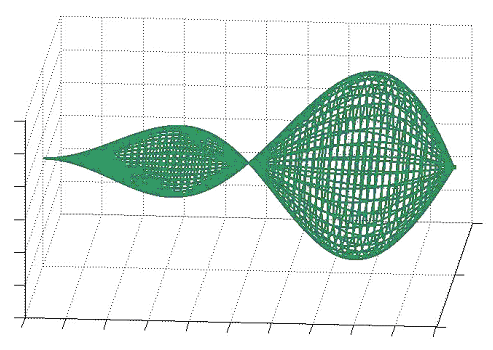
The surface of revolution of the function x⋅sin(x) on the interval [0,2π]
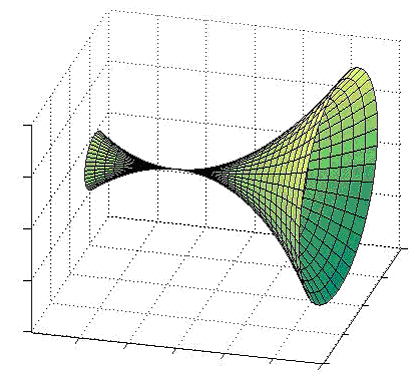
The surface of revolution of the function x2 on the interval [−2,4]
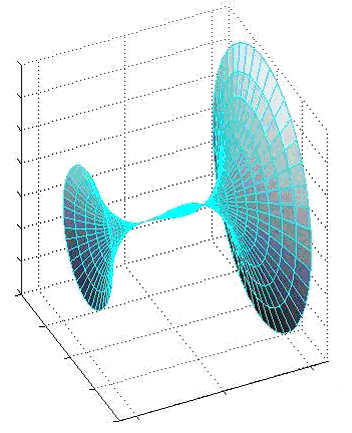
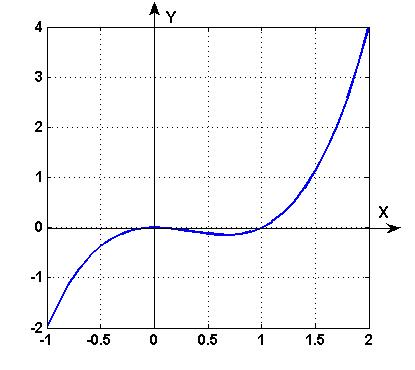
The surface of revolution of the function x3−x2 on the interval [−1,2]
- Volume of a solid of revolution
Let f:[a,b]→R be a continuous function. The set of points in space:
V={(x,y,z)∈R3∣y2+z2≤∣f(x)∣,x∈[a,b]}
is called the solid of revolution determined by the function f about the
Ox axis.
Let f:[a,b]→R be a differentiable function with continuous derivative. The solid of
revolution determined by f has volume:
V(f)=π∫abf2(x)dx
- Centre of mass
Let E be a plane lamina bounded by the continuous functions f,g:[a,b]→R. The
centre of mass of E is the point with coordinates:
xG=a∫b(g(x)−f(x))dxa∫bx(g(x)−f(x))dx, yG=a∫b(g(x)−f(x))dx21⋅a∫b(g2(x)−f2(x))dx