1. Sequences and limits.
Definition 1.1 A sequence of real numbers f : N → R , f ( n ) = a n f:N\to R,f\left( n \right)={{a}_{n}} f : N → R , f ( n ) = a n
Definition 1.2 The sequence ( a n ) n ≥ 0 \left( {{a}_{n}} \right)n\ge 0 ( a n ) n ≥ 0 increasing decreasing a n ≤ a n + 1 , ∀ n ∈ N {{a}_{n}}\le {{a}_{n+1}},\forall n\in N a n ≤ a n + 1 , ∀ n ∈ N a n ≥ a n + 1 , ∀ n ∈ N {{a}_{n}}\ge {{a}_{n+1}},\forall n\in N a n ≥ a n + 1 , ∀ n ∈ N monotonic sequences.
Definition 1.3 The sequence ( a n ) n ≥ 0 \left( {{a}_{n}} \right)n\ge 0 ( a n ) n ≥ 0 bounded ∃ M > 0 \exists M>0 ∃ M > 0 ∣ a n ∣ ≤ M , ∀ n ∈ N \left| {{a}_{n}} \right|\le M,\forall n\in N ∣ a n ∣ ≤ M , ∀ n ∈ N
Notation: ( a n ) n ≥ 0 , a n ∈ R , R ˉ = R ∪ { − ∞ , + ∞ } {{\left( {{a}_{n}} \right)}_{n\ge 0}}, {{a}_{n}}\in R,\text{ }\bar{R}=R\cup \left\{ -\infty ,+\infty \right\} ( a n ) n ≥ 0 , a n ∈ R , R ˉ = R ∪ { − ∞ , + ∞ }
Definition 1.5 The sequence is convergent lim x → ∞ a n = a , a ∈ R \displaystyle \underset{x\to \infty }{\mathop{\lim }}\,{{a}_{n}}=a,\text{ }a\in R x → ∞ lim a n = a , a ∈ R ∀ ε > 0 , ∃ N ε ∈ N \forall \varepsilon >0, \exists {{N}_{\varepsilon }}\in N ∀ ε > 0 , ∃ N ε ∈ N ∀ n > N ε , ∣ a n − a ∣ < ε \forall n>{{N}_{\varepsilon }}, \left| {{a}_{n}}-a \right|<\varepsilon ∀ n > N ε , ∣ a n − a ∣ < ε
Definition 1.6 lim x → ∞ a n = ∞ \displaystyle \underset{x\to \infty }{\mathop{\lim }}\,{{a}_{n}}=\infty x → ∞ lim a n = ∞ ( ∀ ) ε > 0 , ( ∃ ) N ε ∈ N (\forall )\varepsilon >0,\text{ (}\exists ) {{N}_{\varepsilon }}\in N ( ∀ ) ε > 0 , ( ∃ ) N ε ∈ N a n > ε , ∀ n > N ε {{a}_{n}}>\varepsilon ,\forall n>{{N}_{\varepsilon }} a n > ε , ∀ n > N ε
Definition 1.7 lim x → ∞ a n = − ∞ \displaystyle \underset{x\to \infty }{\mathop{\lim }}\,{{a}_{n}}=-\infty x → ∞ lim a n = − ∞ ∀ ε > 0 , ∃ N ε ∈ N \forall \varepsilon >0,\exists {{N}_{\varepsilon }}\in N ∀ ε > 0 , ∃ N ε ∈ N a n < − ε , ∀ n > N ε {{a}_{n}}<-\varepsilon , \forall n>{{N}_{\varepsilon }} a n < − ε , ∀ n > N ε
If lim x → ∞ a n = ± ∞ \displaystyle \underset{x\to \infty }{\mathop{\lim }}\,{{a}_{n}}=\pm \infty x → ∞ lim a n = ± ∞ divergent
A sequence ( a n ) n ≥ 1 {{\left( {{a}_{n}} \right)}_{n\ge 1}} ( a n ) n ≥ 1
descriptively (e.g. 1,3,5,7,9,…);
by a formula for the general term (e.g. b n = n 2 − n + 1 {{b}_{n}}={{n}^{2}}-n+1 b n = n 2 − n + 1
by a recurrence formula (e.g. b 1 = 1 {{b}_{1}}=1 b 1 = 1 b 2 = 2 {{b}_{2}}=2 b 2 = 2 b n + 2 = b n + b n + 1 {{b}_{n+2}}={{b}_{n}}+{{b}_{n+1}} b n + 2 = b n + b n + 1
2. Sufficient criteria for convergence, or for a sequence to have a limit.
1. if lim n → ∞ b n = 0 , b n ≥ 0 \displaystyle \underset{n\to \infty }{\mathop{\lim }}\,{{b}_{n}}=0, {{b}_{n}}\ge 0 n → ∞ lim b n = 0 , b n ≥ 0 ∣ a n − a ∣ ≤ b n \left| {{a}_{n}}-a \right|\le {{b}_{n}} ∣ a n − a ∣ ≤ b n lim n → ∞ a n = a \displaystyle \underset{n\to \infty }{\mathop{\lim }}\,{{a}_{n}}=a n → ∞ lim a n = a
2. if lim n → ∞ b n = ∞ \displaystyle \underset{n\to \infty }{\mathop{\lim }}\,{{b}_{n}}=\infty n → ∞ lim b n = ∞ a n ≥ b n {{a}_{n}}\ge {{b}_{n}} a n ≥ b n lim x → ∞ a n = + ∞ \displaystyle \underset{x\to \infty }{\mathop{\lim }}\,{{a}_{n}}=+\infty x → ∞ lim a n = + ∞
3. if lim n → ∞ b n = − ∞ \displaystyle \underset{n\to \infty }{\mathop{\lim }}\,{{b}_{n}}=-\infty n → ∞ lim b n = − ∞ a n ≤ b n {{a}_{n}}\le {{b}_{n}} a n ≤ b n lim x → ∞ a n = − ∞ \displaystyle \underset{x\to \infty }{\mathop{\lim }}\,{{a}_{n}}=-\infty x → ∞ lim a n = − ∞
4. every monotonic bounded sequence is convergent (Weierstrass's
criterion);
5. if b n ≤ a n ≤ c n {{b}_{n}}\le {{a}_{n}}\le {{c}_{n}} b n ≤ a n ≤ c n lim n → ∞ b n = lim n → ∞ c n = a \displaystyle \underset{n\to \infty }{\mathop{\lim }}\,{{b}_{n}}=\underset{n\to \infty }{\mathop{\lim }}\,{{c}_{n}}=a n → ∞ lim b n = n → ∞ lim c n = a lim n → ∞ a n = a \displaystyle \underset{n\to \infty }{\mathop{\lim }}\,{{a}_{n}}=a n → ∞ lim a n = a
6. Stolz's criterion:
- if ( b n ) n ≥ 0 {{\left( {{b}_{n}} \right)}_{n\ge 0}} ( b n ) n ≥ 0 lim n → ∞ b n = + ∞ \displaystyle \underset{n\to \infty }{\mathop{\lim }}\,{{b}_{n}}=+\infty n → ∞ lim b n = + ∞ lim n → ∞ a n + 1 − a n b n + 1 − b n \displaystyle \underset{n\to \infty }{\mathop{\lim }}\,\frac{{{a}_{n+1}}-{{a}_{n}}}{{{b}_{n+1}}-{{b}_{n}}} n → ∞ lim b n + 1 − b n a n + 1 − a n lim n → ∞ a n b n = lim n → ∞ a n + 1 − a n b n + 1 − b n \displaystyle \underset{n\to \infty }{\mathop{\lim }}\,\frac{{{a}_{n}}}{{{b}_{n}}}=\underset{n\to \infty }{\mathop{\lim }}\,\frac{{{a}_{n+1}}-{{a}_{n}}}{{{b}_{n+1}}-{{b}_{n}}} n → ∞ lim b n a n = n → ∞ lim b n + 1 − b n a n + 1 − a n
- if ( a n ) n ≥ 0 {{\left( {{a}_{n}} \right)}_{n\ge 0}} ( a n ) n ≥ 0 a n > 0 {{a}_{n}}>0 a n > 0 lim n → ∞ a n + 1 a n \displaystyle \underset{n\to \infty }{\mathop{\lim }}\,\frac{{{a}_{n+1}}}{{{a}_{n}}} n → ∞ lim a n a n + 1 lim n → ∞ a n n = lim x → ∞ a n + 1 a n \displaystyle \underset{n\to \infty }{\mathop{\lim }}\,\sqrt[n]{{{a}_{n}}}=\underset{x\to \infty }{\mathop{\lim }}\,\frac{{{a}_{n+1}}}{{{a}_{n}}} n → ∞ lim n a n = x → ∞ lim a n a n + 1
- if ( b n ) n ≥ 0 {{\left( {{b}_{n}} \right)}_{n\ge 0}} ( b n ) n ≥ 0 lim n → ∞ a n = lim n → ∞ b n = 0 \displaystyle \underset{n\to \infty }{\mathop{\lim }}\,{{a}_{n}}=\underset{n\to \infty }{\mathop{\lim }}\,{{b}_{n}}=0 n → ∞ lim a n = n → ∞ lim b n = 0 lim n → ∞ a n + 1 − a n b n + 1 − b n \displaystyle \underset{n\to \infty }{\mathop{\lim }}\,\frac{{{a}_{n+1}}-{{a}_{n}}}{{{b}_{n+1}}-{{b}_{n}}} n → ∞ lim b n + 1 − b n a n + 1 − a n lim n → ∞ a n b n = lim n → ∞ a n + 1 − a n b n + 1 − b n \displaystyle \underset{n\to \infty }{\mathop{\lim }}\,\frac{{{a}_{n}}}{{{b}_{n}}}=\underset{n\to \infty }{\mathop{\lim }}\,\frac{{{a}_{n+1}}-{{a}_{n}}}{{{b}_{n+1}}-{{b}_{n}}} n → ∞ lim b n a n = n → ∞ lim b n + 1 − b n a n + 1 − a n
7. The ratio test.
Let ( a n ) n ≥ 1 {{\left( {{a}_{n}} \right)}_{n\ge 1}} ( a n ) n ≥ 1 lim n → ∞ a n + 1 a n = l \displaystyle \underset{n\to \infty }{\mathop{\lim }}\,\frac{{{a}_{n+1}}}{{{a}_{n}}}=l n → ∞ lim a n a n + 1 = l
if l < 1 ⇒ l<1\Rightarrow l < 1 ⇒ lim n → ∞ a n = 0 \displaystyle \underset{n\to \infty }{\mathop{\lim }}\,{{a}_{n}}=0 n → ∞ lim a n = 0
if l ∈ ( 1 , ∞ ] ⇒ l\in (1,\infty ]\Rightarrow l ∈ ( 1 , ∞ ] ⇒ lim n → ∞ a n = ∞ \displaystyle \underset{n\to \infty }{\mathop{\lim }}\,{{a}_{n}}=\infty n → ∞ lim a n = ∞
3. Operations with convergent sequences
lim n → ∞ a n = a , lim n → ∞ b n = b a , b ∈ R ˉ \displaystyle \underset{n\to \infty }{\mathop{\lim }}\,{{a}_{n}}=a, \underset{n\to \infty }{\mathop{\lim }}\,{{b}_{n}}=b\text{ }a, b\in \bar{R} n → ∞ lim a n = a , n → ∞ lim b n = b a , b ∈ R ˉ
1.lim n → ∞ ( a n + b n ) = a + b , lim n → ∞ ( a n ⋅ b n ) = a ⋅ b \displaystyle \underset{n\to \infty }{\mathop{\lim }}\,\left( {{a}_{n}}+{{b}_{n}} \right)=a+b,\text{ }\underset{n\to \infty }{\mathop{\lim }}\,\left( {{a}_{n}}\cdot {{b}_{n}} \right)=a\cdot b n → ∞ lim ( a n + b n ) = a + b , n → ∞ lim ( a n ⋅ b n ) = a ⋅ b
2.lim n → ∞ α ⋅ a n = α ⋅ a , α ∈ R \displaystyle \underset{n\to \infty }{\mathop{\lim }}\,\alpha \cdot {{a}_{n}}=\alpha \cdot a,\text{ }\alpha \in R n → ∞ lim α ⋅ a n = α ⋅ a , α ∈ R
3.lim n → ∞ a n b n = a b \displaystyle \underset{n\to \infty }{\mathop{\lim }}\,\frac{{{a}_{n}}}{{{b}_{n}}}=\frac{a}{b} n → ∞ lim b n a n = b a b ≠ 0 b\ne 0 b = 0
4. Operations with sequences that have a limit.
lim n → ∞ a n = a , lim n → ∞ b n = b a , b ∈ R ˉ \displaystyle \underset{n\to \infty }{\mathop{\lim }}\,{{a}_{n}}=a, \underset{n\to \infty }{\mathop{\lim }}\,{{b}_{n}}=b\text{ }a,b\in \bar{R} n → ∞ lim a n = a , n → ∞ lim b n = b a , b ∈ R ˉ
if lim n → ∞ a n = ∞ \displaystyle \underset{n\to \infty }{\mathop{\lim }}\,{{a}_{n}}=\infty n → ∞ lim a n = ∞ lim n → ∞ b n = b , b ∈ R \displaystyle \underset{n\to \infty }{\mathop{\lim }}\,{{b}_{n}}=b,\text{ }b\in R n → ∞ lim b n = b , b ∈ R lim n → ∞ ( a n + b n ) = + ∞ \displaystyle \underset{n\to \infty }{\mathop{\lim }}\,\left( {{a}_{n}}+{{b}_{n}} \right)=+\infty n → ∞ lim ( a n + b n ) = + ∞ lim n → ∞ a n ⋅ b n = { + ∞ , d a c a ˘ b > 0 − ∞ , d a c a ˘ b < 0 , lim n → ∞ 1 a n = 0 \displaystyle \underset{n\to \infty }{\mathop{\lim }}\,{{a}_{n}}\cdot {{b}_{n}}=\left\{ \begin{aligned} & +\infty ,\, \,dac\breve{a}\,\,b>0 \\ & -\infty , \,\,dac\breve{a}\,\,b<0 \\ \end{aligned} \right.,\text{ }\underset{n\to \infty }{\mathop{\lim }}\,\frac{1}{{{a}_{n}}}=0 n → ∞ lim a n ⋅ b n = { + ∞ , d a c a ˘ b > 0 − ∞ , d a c a ˘ b < 0 , n → ∞ lim a n 1 = 0
if lim n → ∞ a n = lim n → ∞ b n = + ∞ \displaystyle \underset{n\to \infty }{\mathop{\lim }}\,{{a}_{n}}=\underset{n\to \infty }{\mathop{\lim }}\,{{b}_{n}}=+\infty n → ∞ lim a n = n → ∞ lim b n = + ∞ lim n → ∞ ( a n + b n ) = + ∞ , \displaystyle \underset{n\to \infty }{\mathop{\lim }}\,\left( {{a}_{n}}+{{b}_{n}} \right)=+\infty , n → ∞ lim ( a n + b n ) = + ∞ , lim n → ∞ a n ⋅ b n = + ∞ \displaystyle \underset{n\to \infty }{\mathop{\lim }}\,{{a}_{n}}\cdot {{b}_{n}}=+\infty n → ∞ lim a n ⋅ b n = + ∞
if lim n → ∞ a n = − ∞ \displaystyle \underset{n\to \infty }{\mathop{\lim }}\,{{a}_{n}}=-\infty n → ∞ lim a n = − ∞ lim n → ∞ b n = b , b ∈ R \displaystyle \underset{n\to \infty }{\mathop{\lim }}\,{{b}_{n}}=b,\text{ }\,\,b\in R n → ∞ lim b n = b , b ∈ R lim n → ∞ ( a n + b n ) = − ∞ \displaystyle \underset{n\to \infty }{\mathop{\lim }}\,\left( {{a}_{n}}+{{b}_{n}} \right)=-\infty n → ∞ lim ( a n + b n ) = − ∞ lim n → ∞ a n ⋅ b n = { − ∞ , d a c a ˘ b > 0 + ∞ , d a c a ˘ b < 0 ; \displaystyle \underset{n\to \infty }{\mathop{\lim }}\,{{a}_{n}}\cdot {{b}_{n}}=\left\{ \begin{aligned} & -\infty \,, \,dac\breve{a}\,\,b>0 \\ & +\infty ,\,\text{ }\,dac\breve{a}\,\,b<0 \\ \end{aligned} \right.; n → ∞ lim a n ⋅ b n = { − ∞ , d a c a ˘ b > 0 + ∞ , d a c a ˘ b < 0 ;
if lim n → ∞ a n = lim n → ∞ b n = − ∞ \displaystyle \underset{n\to \infty }{\mathop{\lim }}\,{{a}_{n}}=\underset{n\to \infty }{\mathop{\lim }}\,{{b}_{n}}=-\infty n → ∞ lim a n = n → ∞ lim b n = − ∞ lim n → ∞ ( a n + b n ) = − ∞ , \displaystyle \underset{n\to \infty }{\mathop{\lim }}\,\left( {{a}_{n}}+{{b}_{n}} \right)=-\infty , n → ∞ lim ( a n + b n ) = − ∞ , lim n → ∞ a n ⋅ b n = + ∞ \displaystyle \underset{n\to \infty }{\mathop{\lim }}\,{{a}_{n}}\cdot {{b}_{n}}=+\infty n → ∞ lim a n ⋅ b n = + ∞
if lim n → ∞ a n = + ∞ \displaystyle \underset{n\to \infty }{\mathop{\lim }}\,{{a}_{n}}=+\infty n → ∞ lim a n = + ∞ lim n → ∞ b n = − ∞ \displaystyle \underset{n\to \infty }{\mathop{\lim }}\,{{b}_{n}}=-\infty n → ∞ lim b n = − ∞ lim n → ∞ a n ⋅ b n = − ∞ \displaystyle \underset{n\to \infty }{\mathop{\lim }}\,{{a}_{n}}\cdot {{b}_{n}}=-\infty n → ∞ lim a n ⋅ b n = − ∞
if lim n → ∞ a n = 0 \displaystyle \underset{n\to \infty }{\mathop{\lim }}\,{{a}_{n}}=0 n → ∞ lim a n = 0 lim n → ∞ 1 a n = ∞ \displaystyle \underset{n\to \infty }{\mathop{\lim }}\,\frac{1}{{{a}_{n}}}=\infty n → ∞ lim a n 1 = ∞ a n > 0 {{a}_{n}}>0 a n > 0 lim n → ∞ 1 a n = − ∞ \displaystyle \underset{n\to \infty }{\mathop{\lim }}\,\frac{1}{{{a}_{n}}}=-\infty n → ∞ lim a n 1 = − ∞ a n < 0 {{a}_{n}}<0 a n < 0
6. Indeterminate forms
± ∞ ± ∞ , 0 0 , ∞ − ∞ , ∞ ⋅ 0 , 1 ∞ , ∞ 0 , 0 0 \frac{\pm \infty }{\pm \infty }, \frac{0}{0}, \infty -\infty , \infty \cdot 0, {{1}^{\infty }}, {{\infty }^{0}}, {{0}^{0}} ± ∞ ± ∞ , 0 0 , ∞ − ∞ , ∞ ⋅ 0 , 1 ∞ , ∞ 0 , 0 0
6. Standard sequences
1.lim n → ∞ q n = { 0 , d a c a ˘ − 1 < q < 1 1 , d a c a ˘ q = 1 + ∞ , d a c a ˘ q > 1 n u e x i s t a ˘ , d a c a ˘ q ≤ − 1 ; \displaystyle \underset{n\to \infty }{\mathop{\lim }}\,{{q}^{n}}=\left\{ \begin{aligned} & 0,\,dac\breve{a}\,\,-1<q<1 \\ & 1,\,dac\breve{a}\,\,q=1 \\ & +\infty ,\,\,dac\breve{a}\,\,q>1 \\ & nu\,\,exist\breve{a},\,\,dac\breve{a}\,\,q\le -1 \\ \end{aligned} \right.; n → ∞ lim q n = ⎩ ⎨ ⎧ 0 , d a c a ˘ − 1 < q < 1 1 , d a c a ˘ q = 1 + ∞ , d a c a ˘ q > 1 n u e x i s t a ˘ , d a c a ˘ q ≤ − 1 ;
2.lim n → ∞ ( a 0 n k + a 1 n k − 1 + . . . + a k − 1 n + a k ) = lim n → ∞ a 0 n k = { + ∞ , d a c a ˘ a 0 > 0 − ∞ , d a c a ˘ a 0 < 0 ; \displaystyle \underset{n\to \infty }{\mathop{\lim }}\,\left( {{a}_{0}}{{n}^{k}}+{{a}_{1}}{{n}^{k-1}}+...+{{a}_{k-1}}n+{{a}_{k}} \right)=\underset{n\to \infty }{\mathop{\lim }}\,{{a}_{0}}{{n}^{k}}=\left\{ \begin{aligned} & +\infty ,\,\,dac\breve{a}\,\,{{a}_{0}}>0 \\ & -\infty ,\,\,dac\breve{a}\,\,{{a}_{0}}<0 \\ \end{aligned} \right.; n → ∞ lim ( a 0 n k + a 1 n k − 1 + ... + a k − 1 n + a k ) = n → ∞ lim a 0 n k = { + ∞ , d a c a ˘ a 0 > 0 − ∞ , d a c a ˘ a 0 < 0 ;
3.lim n → ∞ a 0 n k + a 1 n k − 1 + . . . + a k − 1 n + a k b 0 n p + b 1 n p − 1 + . . . + b p − 1 n + b p = { 0 , d a c a ˘ k < p + ∞ , d a c a ˘ k > p i a 0 p 0 > 0 − ∞ , d a c a ˘ k > p i a 0 p 0 < 0 a 0 b 0 , d a c a ˘ k = p \displaystyle \underset{n\to \infty }{\mathop{\lim }}\,\frac{{{a}_{0}}{{n}^{k}}+{{a}_{1}}{{n}^{k-1}}+...+{{a}_{k-1}}n+{{a}_{k}}}{{{b}_{0}}{{n}^{p}}+{{b}_{1}}{{n}^{p-1}}+...+{{b}_{p-1}}n+{{b}_{p}}}=\left\{ \begin{aligned} & 0,\, dac\breve{a}\,k<p \\ & +\infty ,\, dac\breve{a}\,k>p\, i\, {{a}_{0}}{{p}_{0}}>0 \\ & -\infty , \,dac\breve{a}\,k>p \,i\, {{a}_{0}}{{p}_{0}}<0 \\ & \frac{{{a}_{0}}}{{{b}_{0}}}, \,dac\breve{a}\,k=p \\ \end{aligned} \right. n → ∞ lim b 0 n p + b 1 n p − 1 + ... + b p − 1 n + b p a 0 n k + a 1 n k − 1 + ... + a k − 1 n + a k = ⎩ ⎨ ⎧ 0 , d a c a ˘ k < p + ∞ , d a c a ˘ k > p i a 0 p 0 > 0 − ∞ , d a c a ˘ k > p i a 0 p 0 < 0 b 0 a 0 , d a c a ˘ k = p
4.lim n → ∞ ( 1 + q + q 2 + . . . + q n ) = 1 1 − q , d a c a ˘ ∣ q ∣ < 1 \displaystyle \underset{n\to \infty }{\mathop{\lim }}\,\left( 1+q+{{q}^{2}}+...+{{q}^{n}} \right)=\frac{1}{1-q},\,\text{ }dac\breve{a}\left| q \right|<1 n → ∞ lim ( 1 + q + q 2 + ... + q n ) = 1 − q 1 , d a c a ˘ ∣ q ∣ < 1
5.lim n → ∞ ( 1 + 1 2 + 1 3 + . . . + 1 n ) = + ∞ \displaystyle \underset{n\to \infty }{\mathop{\lim }}\,\left( 1+\frac{1}{2}+\frac{1}{3}+...+\frac{1}{n} \right)=+\infty n → ∞ lim ( 1 + 2 1 + 3 1 + ... + n 1 ) = + ∞
6.lim n → ∞ a n = 1 , ∀ a > 0 \displaystyle \underset{n\to \infty }{\mathop{\lim }}\,\sqrt[n]{a}=1, \,\forall a>0 n → ∞ lim n a = 1 , ∀ a > 0
7.lim n → ∞ 1 p + 2 p + . . . + n p n = 1 , ∀ p ≥ 1 \displaystyle \underset{n\to \infty }{\mathop{\lim }}\,\sqrt[n]{{{1}^{p}}+{{2}^{p}}+...+{{n}^{p}}}=1, \,\forall p\ge 1 n → ∞ lim n 1 p + 2 p + ... + n p = 1 , ∀ p ≥ 1
8.lim n → ∞ ( 1 + 1 n ) n = e \displaystyle \underset{n\to \infty }{\mathop{\lim }}\,{{\left( 1+\frac{1}{n} \right)}^{n}}=e n → ∞ lim ( 1 + n 1 ) n = e
9.lim n → ∞ ( 1 + 1 1 ! + 1 2 ! + . . . + 1 n ! ) = e \displaystyle \underset{n\to \infty }{\mathop{\lim }}\,\left( 1+\frac{1}{1!}+\frac{1}{2!}+...+\frac{1}{n!} \right)=e n → ∞ lim ( 1 + 1 ! 1 + 2 ! 1 + ... + n ! 1 ) = e
10. lim n → ∞ n n = 1 \displaystyle \underset{n\to \infty }{\mathop{\lim }}\,\sqrt[n]{n}=1 n → ∞ lim n n = 1
11. lim n → ∞ a n = 1 \displaystyle \underset{n\to \infty }{\mathop{\lim }}\,\sqrt[n]{a}=1 n → ∞ lim n a = 1
12. lim n → ∞ ( 1 + 1 n ) p − 1 1 n = p \displaystyle \underset{n\to \infty }{\mathop{\lim }}\,\frac{{{\left( 1+\frac{1}{n} \right)}^{p}}-1}{\frac{1}{n}}=p n → ∞ lim n 1 ( 1 + n 1 ) p − 1 = p
13. lim n → ∞ a n n ! = 0 \displaystyle \underset{n\to \infty }{\mathop{\lim }}\,\frac{{{a}^{n}}}{n!}=0 n → ∞ lim n ! a n = 0 lim n → ∞ n n n ! = 0 \displaystyle \underset{n\to \infty }{\mathop{\lim }}\,\frac{{{n}^{n}}}{n!}=0 n → ∞ lim n ! n n = 0
14. lim n → ∞ ln ( 1 + 1 n ) 1 n = 1 \displaystyle \underset{n\to \infty }{\mathop{\lim }}\,\frac{\ln \left( 1+\frac{1}{n} \right)}{\frac{1}{n}}=1 n → ∞ lim n 1 ln ( 1 + n 1 ) = 1
15. lim n → ∞ ( u n ) v n = lim n → ∞ e v n ( u n − 1 ) \displaystyle \underset{n\to \infty }{\mathop{\lim }}\,{{({{u}_{n}})}^{{{v}_{n}}}}=\underset{n\to \infty }{\mathop{\lim }}\,{{e}^{{{v}_{n}}({{u}_{n}}-1)}} n → ∞ lim ( u n ) v n = n → ∞ lim e v n ( u n − 1 )
Limits of functions
Notation: f : D → R , D ⊂ R , α f:D\to R,D\subset R,\alpha f : D → R , D ⊂ R , α D ;
1. Definitions of the limit
Definition 1.1 lim x → ∞ f ( x ) = l , l ∈ R ˉ \displaystyle \underset{x\to \infty }{\mathop{\lim }}\,f\left( x \right)=l,l\in \bar{R} x → ∞ lim f ( x ) = l , l ∈ R ˉ V of l there is a
neighbourhood U of α \alpha α ∀ x ∈ D ∩ U , x ≠ α \forall x\in D\cap U,x\ne \alpha ∀ x ∈ D ∩ U , x = α f ( x ) ∈ V f\left( x \right)\in V f ( x ) ∈ V
Definition 1.2 lim x → ∞ f ( x ) = l , l ∈ R ˉ \displaystyle \underset{x\to \infty }{\mathop{\lim }}\,f\left( x \right)=l, l\in \bar{R} x → ∞ lim f ( x ) = l , l ∈ R ˉ ( x n ) n ≥ 0 {{\left( {{x}_{n}} \right)}_{n\ge 0}} ( x n ) n ≥ 0 x n ∈ D \ { α } {{x}_{n}}\in D\backslash \left\{ \alpha \right\} x n ∈ D \ { α } lim x → ∞ x n = α \displaystyle \underset{x\to \infty }{\mathop{\lim }}\,{{x}_{n}}=\alpha x → ∞ lim x n = α lim x → ∞ f ( x n ) = l \displaystyle \underset{x\to \infty }{\mathop{\lim }}\,f\left( {{x}_{n}} \right)=l x → ∞ lim f ( x n ) = l
Definition 1.3 lim x → ∞ f ( x ) = l , l ∈ R ˉ \displaystyle \underset{x\to \infty }{\mathop{\lim }}\,f\left( x \right)=l,\, l\in \bar{R} x → ∞ lim f ( x ) = l , l ∈ R ˉ ∀ ε > 0 , ∃ δ ε > 0 \forall \varepsilon >0, \exists {{\delta }_{\varepsilon }}>0 ∀ ε > 0 , ∃ δ ε > 0 ∀ x ∈ D \ { α } \forall x\in D\backslash \left\{ \alpha \right\} ∀ x ∈ D \ { α } ∣ x − α ∣ < δ ε \left| x-\alpha \right|<{{\delta }_{\varepsilon }} ∣ x − α ∣ < δ ε ∣ f ( x ) − l ∣ < ε \left| f\left( x \right)-l \right|<\varepsilon ∣ f ( x ) − l ∣ < ε
Definition 1.4 lim x → ∞ f ( x ) = l \displaystyle \underset{x\to \infty }{\mathop{\lim }}\,f\left( x \right)=l x → ∞ lim f ( x ) = l l s = l d = l {{l}_{s}}={{l}_{d}}=l l s = l d = l l s = lim x → ∞ x < α f ( x ) \displaystyle {{l}_{s}}=\underset{\begin{smallmatrix} x\to \infty \\ x<\alpha \end{smallmatrix}}{\mathop{\lim }}\,f\left( x \right) l s = x → ∞ x < α lim f ( x ) l d = lim x → ∞ x > α f ( x ) \displaystyle {{l}_{d}}=\underset{\begin{smallmatrix} x\to \infty \\ x>\alpha \end{smallmatrix}}{\mathop{\lim }}\,f\left( x \right) l d = x → ∞ x > α lim f ( x )
2. Operations with limits of functions
f : D → R , g : D → R , α f:D\to R,g:D\to R,\alpha f : D → R , g : D → R , α D , lim x → α f ( x ) = l 1 , lim x → α g ( x ) = l 2 , l 1 , l 2 ∈ R \displaystyle \underset{x\to \alpha }{\mathop{\lim }}\,f\left( x \right)={{l}_{1}},\text{ }\underset{x\to \alpha }{\mathop{\lim }}\,g\left( x \right)={{l}_{2}}, {{l}_{1}}, {{l}_{2}}\in R x → α lim f ( x ) = l 1 , x → α lim g ( x ) = l 2 , l 1 , l 2 ∈ R
1.lim x → α ( f ( x ) + g ( x ) ) = l 1 + l 2 \displaystyle \underset{x\to \alpha }{\mathop{\lim }}\,\left( f\left( x \right)+g\left( x \right) \right)={{l}_{1}}+{{l}_{2}} x → α lim ( f ( x ) + g ( x ) ) = l 1 + l 2
2.lim x → α f ( x ) ⋅ g ( x ) = l 1 ⋅ l 2 \displaystyle \underset{x\to \alpha }{\mathop{\lim }}\,f\left( x \right)\cdot g\left( x \right)={{l}_{1}}\cdot {{l}_{2}} x → α lim f ( x ) ⋅ g ( x ) = l 1 ⋅ l 2
3.lim x → α a f ( x ) = a ⋅ l 1 , ∀ a ∈ R \displaystyle \underset{x\to \alpha }{\mathop{\lim }}\,af\left( x \right)=a\cdot {{l}_{1}},\forall a\in R x → α lim a f ( x ) = a ⋅ l 1 , ∀ a ∈ R
if l 2 ≠ 0 , lim x → ∞ f ( x ) g ( x ) = l 1 l 2 \displaystyle {{l}_{2}}\ne 0,\text{ }\underset{x\to \infty }{\mathop{\lim }}\,\frac{f\left( x \right)}{g\left( x \right)}=\frac{{{l}_{1}}}{{{l}_{2}}} l 2 = 0 , x → ∞ lim g ( x ) f ( x ) = l 2 l 1
3. Standard limits
1.lim x → α ( a 0 x n + a 1 x n − 1 + . . . + a n ) = a 0 α n + a 1 α n − 1 + . . . + a n \displaystyle \underset{x\to \alpha }{\mathop{\lim }}\,\left( {{a}_{0}}{{x}^{n}}+{{a}_{1}}{{x}^{n-1}}+...+{{a}_{n}} \right)={{a}_{0}}{{\alpha }^{n}}+{{a}_{1}}{{\alpha }^{n-1}}+...+{{a}_{n}} x → α lim ( a 0 x n + a 1 x n − 1 + ... + a n ) = a 0 α n + a 1 α n − 1 + ... + a n
lim x → ± ∞ ( a 0 x n + a 1 x n − 1 + . . . + a n ) = lim x → ∞ a 0 x n \displaystyle \underset{x\to \pm \infty }{\mathop{\lim }}\,\left( {{a}_{0}}{{x}^{n}}+{{a}_{1}}{{x}^{n-1}}+...+{{a}_{n}} \right)=\underset{x\to \infty }{\mathop{\lim }}\,{{a}_{0}}{{x}^{n}} x → ± ∞ lim ( a 0 x n + a 1 x n − 1 + ... + a n ) = x → ∞ lim a 0 x n
2.lim x → α a 0 x n + a 1 x n − 1 + . . . + a n b 0 x m + b 1 x m − 1 + . . . + b m = a 0 α n + a 1 α n − 1 + . . . + a n b 0 α m + b 1 α m − 1 + . . . + b m \displaystyle \underset{x\to \alpha }{\mathop{\lim }}\,\frac{{{a}_{0}}{{x}^{n}}+{{a}_{1}}{{x}^{n-1}}+...+{{a}_{n}}}{{{b}_{0}}{{x}^{m}}+{{b}_{1}}{{x}^{m-1}}+...+{{b}_{m}}}=\frac{{{a}_{0}}{{\alpha }^{n}}+{{a}_{1}}{{\alpha }^{n-1}}+...+{{a}_{n}}}{{{b}_{0}}{{\alpha }^{m}}+{{b}_{1}}{{\alpha }^{m-1}}+...+{{b}_{m}}} x → α lim b 0 x m + b 1 x m − 1 + ... + b m a 0 x n + a 1 x n − 1 + ... + a n = b 0 α m + b 1 α m − 1 + ... + b m a 0 α n + a 1 α n − 1 + ... + a n
lim x → ± ∞ a 0 x n + a 1 x n − 1 + . . . + a n b 0 x m + b 1 x m − 1 + . . . + b m = lim x → ± ∞ a 0 x n b 0 x m \displaystyle \underset{x\to \pm \infty }{\mathop{\lim }}\,\frac{{{a}_{0}}{{x}^{n}}+{{a}_{1}}{{x}^{n-1}}+...+{{a}_{n}}}{{{b}_{0}}{{x}^{m}}+{{b}_{1}}{{x}^{m-1}}+...+{{b}_{m}}}=\underset{x\to \pm \infty }{\mathop{\lim }}\,\frac{{{a}_{0}}{{x}^{n}}}{{{b}_{0}}{{x}^{m}}} x → ± ∞ lim b 0 x m + b 1 x m − 1 + ... + b m a 0 x n + a 1 x n − 1 + ... + a n = x → ± ∞ lim b 0 x m a 0 x n
3.lim x → α x n = α n , α ∈ R + , n ∈ N , n ≥ 2 \displaystyle \underset{x\to \alpha }{\mathop{\lim }}\,\sqrt[n]{x}=\sqrt[n]{\alpha },\alpha \in {{R}_{+}},n\in N,n\ge 2 x → α lim n x = n α , α ∈ R + , n ∈ N , n ≥ 2
lim x → ∞ x n = ∞ , lim x → − ∞ x 2 n + 1 = − ∞ \displaystyle \underset{x\to \infty }{\mathop{\lim }}\,\sqrt[n]{x}=\infty ,\text{ }\underset{x\to -\infty }{\mathop{\lim }}\,\sqrt[2n+1]{x}=-\infty x → ∞ lim n x = ∞ , x → − ∞ lim 2 n + 1 x = − ∞
4.lim x → α a x = a α , α ∈ R , a ∈ R + ∗ \ { 1 } \displaystyle \underset{x\to \alpha }{\mathop{\lim }}\,{{a}^{x}}={{a}^{\alpha }},\alpha \in R,a\in R_{+}^{*}\backslash \left\{ 1 \right\} x → α lim a x = a α , α ∈ R , a ∈ R + ∗ \ { 1 }
lim x → ∞ a x = ∞ , lim x → ∞ a x = 0 , d a c a ˘ a > 1 \displaystyle \underset{x\to \infty }{\mathop{\lim }}\,{{a}^{x}}=\infty ,\underset{x\to \infty }{\mathop{\lim }}\,{{a}^{x}}=0,\,\text{ }dac\breve{a}\,\,\,\,a>1 x → ∞ lim a x = ∞ , x → ∞ lim a x = 0 , d a c a ˘ a > 1
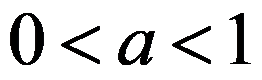
lim x → ∞ a x = 0 , lim x → ∞ a x = ∞ , d a c a ˘ 0 < a < 1 \displaystyle \underset{x\to \infty }{\mathop{\lim }}\,{{a}^{x}}=0,\underset{x\to \infty }{\mathop{\lim }}\,{{a}^{x}}=\infty ,\text{ }\,dac\breve{a}\,\,\,0<a<1 x → ∞ lim a x = 0 , x → ∞ lim a x = ∞ , d a c a ˘ 0 < a < 1
5.lim x → α log a x = log a α , α > 0 \displaystyle \underset{x\to \alpha }{\mathop{\lim }}\,{{\log }_{a}}x={{\log }_{a}}\alpha , \alpha >0 x → α lim log a x = log a α , α > 0 a ∈ R + ∗ \ { 1 } a\in R_{+}^{*}\backslash \left\{ 1 \right\} a ∈ R + ∗ \ { 1 }
lim x → 0 x > 0 log a x = − ∞ \displaystyle \underset{\begin{smallmatrix} x\to 0 \\ x>0 \end{smallmatrix}}{\mathop{\lim }}\,{{\log }_{a}}x=-\infty x → 0 x > 0 lim log a x = − ∞ lim x → ∞ log a x = + ∞ \displaystyle \underset{x\to \infty }{\mathop{\lim }}\,{{\log }_{a}}x=+\infty x → ∞ lim log a x = + ∞ a > 1 a>1 a > 1
lim x → 0 x > 0 log a x = + ∞ \displaystyle \underset{\begin{smallmatrix} x\to 0 \\ x>0 \end{smallmatrix}}{\mathop{\lim }}\,{{\log }_{a}}x=+\infty x → 0 x > 0 lim log a x = + ∞ lim x → ∞ log a x = − ∞ \displaystyle \underset{x\to \infty }{\mathop{\lim }}\,{{\log }_{a}}x=-\infty x → ∞ lim log a x = − ∞
6.lim x → α sin x = sin α \displaystyle \underset{x\to \alpha }{\mathop{\lim }}\,\sin x=\sin \alpha x → α lim sin x = sin α lim x → α cos x = cos α \displaystyle \underset{x\to \alpha }{\mathop{\lim }}\,\cos x=\cos \alpha x → α lim cos x = cos α
lim x → α t g x = t g α , α ∈ π 2 + π Z \displaystyle \underset{x\to \alpha }{\mathop{\lim }}\,tgx=tg\alpha ,\text{ }\alpha \in \frac{\pi }{2}+\pi Z x → α lim t g x = t g α , α ∈ 2 π + π Z
lim x → α c t g x = c t g α , α ∉ π Z \displaystyle \underset{x\to \alpha }{\mathop{\lim }}\,ctgx=ctg\alpha ,\text{ }\alpha \notin \pi Z x → α lim c t g x = c t g α , α ∈ / π Z
lim x → π 2 x < π 2 t g x = ∞ , lim x → π 2 x > π 2 t g x = − ∞ \displaystyle \underset{\begin{smallmatrix} x\to \frac{\pi }{2} \\ x<\frac{\pi }{2} \end{smallmatrix}}{\mathop{\lim }}\,tgx=\infty ,\text{ }\underset{\begin{smallmatrix} x\to \frac{\pi }{2} \\ x>\frac{\pi }{2} \end{smallmatrix}}{\mathop{\lim }}\,tgx=-\infty x → 2 π x < 2 π lim t g x = ∞ , x → 2 π x > 2 π lim t g x = − ∞
7.lim c x → π 2 x < π 2 t g x = ∞ , lim c x → 0 x > 0 t g x = − ∞ \displaystyle \underset{\begin{smallmatrix} x\to \frac{\pi }{2} \\ x<\frac{\pi }{2} \end{smallmatrix}}{\mathop{\lim c}}\,tgx=\infty ,\text{ }\underset{\begin{smallmatrix} x\to 0 \\ x>0 \end{smallmatrix}}{\mathop{\lim c}}\,tgx=-\infty x → 2 π x < 2 π lim c t g x = ∞ , x → 0 x > 0 lim c t g x = − ∞
lim x → α arcsin x = arcsin α , α ∈ [ − 1 , 1 ] \displaystyle \underset{x\to \alpha }{\mathop{\lim }}\,\,\arcsin x=\arcsin \alpha ,\alpha \in \left[ -1,1 \right] x → α lim arcsin x = arcsin α , α ∈ [ − 1 , 1 ]
lim x → α ar cos x = ar cos α , α ∈ [ − 1 , 1 ] \displaystyle \underset{x\to \alpha }{\mathop{\lim }}\,\,\operatorname{ar}\cos x=\operatorname{ar}\cos \alpha ,\alpha \in \left[ -1,1 \right] x → α lim ar cos x = ar cos α , α ∈ [ − 1 , 1 ]
lim x → α a r c t g x = a r c t g α , α ∈ R \displaystyle \underset{x\to \alpha }{\mathop{\lim }}\,\,arctgx=arctg\alpha ,\alpha \in R x → α lim a r c t g x = a r c t g α , α ∈ R
lim x → − ∞ a r c t g x = − π 2 , lim x → ∞ a r c t g x = π 2 \displaystyle \underset{x\to -\infty }{\mathop{\lim }}\,arctgx=-\frac{\pi }{2},\text{ }\underset{x\to \infty }{\mathop{\lim }}\,arctgx=\frac{\pi }{2} x → − ∞ lim a r c t g x = − 2 π , x → ∞ lim a r c t g x = 2 π
lim x → − ∞ a r c c t g x = π , lim x → ∞ a r c c t g x = 0 \displaystyle \underset{x\to -\infty }{\mathop{\lim }}\,arcctgx=\pi ,\text{ }\underset{x\to \infty }{\mathop{\lim }}\,arcctgx=0 x → − ∞ lim a r cc t g x = π , x → ∞ lim a r cc t g x = 0
8.lim x → 0 sin x x = 1 ; lim x → 0 t g x x = 1 ; \displaystyle \underset{x\to 0}{\mathop{\lim }}\,\frac{\sin x}{x}=1;\text{ }\underset{x\to 0}{\mathop{\lim }}\,\frac{tgx}{x}=1; x → 0 lim x sin x = 1 ; x → 0 lim x t g x = 1 ;
lim x → 0 arcsin x x = 1 ; lim x → 0 a r c t g x x = 1 ; \displaystyle \underset{x\to 0}{\mathop{\lim }}\,\frac{\arcsin x}{x}=1;\text{ }\underset{x\to 0}{\mathop{\lim }}\,\frac{arctgx}{x}=1; x → 0 lim x arcsin x = 1 ; x → 0 lim x a r c t g x = 1 ;
9.lim x → ∞ x n a x = 0 , ∀ n ∈ Z , a > 1 \displaystyle \underset{x\to \infty }{\mathop{\lim }}\,\frac{{{x}^{n}}}{{{a}^{x}}}=0,\text{ }\forall n\in Z, a>1 x → ∞ lim a x x n = 0 , ∀ n ∈ Z , a > 1
10.lim x → ± ∞ ( 1 + 1 x ) x = e , lim x → 0 ( 1 + x ) 1 x = e \displaystyle \underset{x\to \pm \infty }{\mathop{\lim }}\,{{\left( 1+\frac{1}{x} \right)}^{x}}=e,\text{ }\underset{x\to 0}{\mathop{\lim }}\,{{\left( 1+x \right)}^{\frac{1}{x}}}=e x → ± ∞ lim ( 1 + x 1 ) x = e , x → 0 lim ( 1 + x ) x 1 = e
11.lim x → 0 ln ( 1 + x ) x = 1 \displaystyle \underset{x\to 0}{\mathop{\lim }}\,\frac{\ln \left( 1+x \right)}{x}=1 x → 0 lim x ln ( 1 + x ) = 1
12.lim x → 0 a x − 1 x = ln a , a > 0 \displaystyle \underset{x\to 0}{\mathop{\lim }}\,\frac{{{a}^{x}}-1}{x}=\ln a,a>0 x → 0 lim x a x − 1 = ln a , a > 0
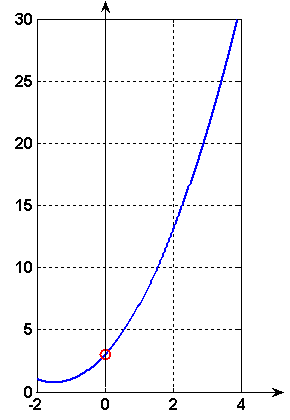
Graph of the function
f ( x ) = ( 1 + x ) r − 1 x = r f(x)=\frac{{{\left( 1+x \right)}^{r}}-1}{x}=r f ( x ) = x ( 1 + x ) r − 1 = r r=3
13.lim x → 0 ( 1 + x ) r − 1 x = r , ∀ r ∈ R \displaystyle \underset{x\to 0}{\mathop{\lim }}\,\frac{{{\left( 1+x \right)}^{r}}-1}{x}=r, \forall r\in R x → 0 lim x ( 1 + x ) r − 1 = r , ∀ r ∈ R
 ;
;