A non-empty subset H of M is called a stable part with respect to the law of
composition "*" if ∀x,y∈H,x∗y∈H.
Properties. The law of composition M×M→M,(x,y)→x∗y
Is commutative if: x∗y=y∗x,∀x,y∈M
Is associative if: (x∗y)∗z=x∗(y∗z),∀x,y,z∈M
Has an identity element if: ∀x∈Me∗x=x∗e=x. The identity element, if it exists, is
unique.
An associative law with an identity element has invertible elements if there
exists x′∈M such that x′∗x=x∗x′=e
If x,y∈M are invertible with respect to a law of composition "*" (associative
and with an identity element), then x*y and x′ are invertible. Moreover:
1) (x∗y)′=y′∗x′ 2) (x′)′=x
Let n∈N,n≥2. On Zn we define the operations called addition and
multiplication of residue classes modulo n as follows: α^+β^=α+β,α^β^=αβ,∀α^,β^∈Zn with α,β∈Tn.
Addition of residue classes modulo n is associative and commutative, has
0^ as identity element, and every residue class has an opposite.
Multiplication of residue classes modulo n is associative, commutative, has
1^ as identity element, and is distributive over addition: a^(b^+c^)=a^b^+a^c^,∀a^,b^,c^∈Zn
Groups
A pair (G,*), consisting of a non-empty set G and a law of composition "*" on
G, is a group if the following conditions hold:
G1) ∀x,y,z∈G,(x∗y)∗z=x∗(y∗z)
G2) ∃e∈G, such that e*x=x*e=x,∀x∈G
G3) ∀x∈G,∃x′∈G with x′∗x=x∗x′=e
If in addition axiom G4∀x,y∈G,x∗y=y∗x holds, then G is called a commutative
or abelian group.
A pair (M,*) consisting of a non-empty set M and a law of composition "*" on
M is called a monoid if:
M1: ∀x,y,z∈M,(x∗y)∗z=x∗(y∗z)
M2: ∃e∈M such that e∗x=x∗e=x,∀x∈M
Cancellation rules in a group*.*
Let (G,*) be a group. For any a,b,c∈G we have:
1) a∗b=a∗c⇒b=c 2) b∗a=c∗a⇒b=c
Let (G,*) be a group, a,b∈G and a′ the inverse of a. The equation
a*x=b has the unique solution x=a′∗b in G, and the equation y*a=b has the
unique solution y=b∗a′ in G.
Let (G,∘) and (G′,∗) be two groups. A function f:G→G′ is called a group
isomorphism if:
1) f(x∘y)=f(x)∗f(y)∀x,y∈G 2) f is bijective
The group G is isomorphic to the group G′(G≃G′) if there exists an isomorphism
f:G→G′.
Let (G,∘) and (G′,∗) be two groups. If f:G→G′ is an isomorphism, then f−1:G′→G is
an isomorphism.
Let the groups (G,∘) and (G′,∗). The function f:G→G′ is called a group
homomorphism if:
f(x∘y)=f(x)∗f(y),∀x,y∈G
Let the groups (G,∘) and (G′,∗) have identity elements e and e′. If f:G→G′
is a group homomorphism, then:
1) f(e)=e′
2) f(x−1)=f(x)−1∀x∈G
Let (G,*) be a group and H a subset of G.
(H,*) is called a subgroup of G if (H,*) is a group.
Let (G,*) be a group with identity element e and H a subgroup of G. Then
e∈H.
Let (G,*) be a group; H⊂G,H=∅.(H,∗) is a subgroup of G if and only if ∀x,y∈H,x∗y∈H,
where y′ is the inverse of y in G.
Let (G, ⋅) be a group with identity element e and a∈G. We say a is
an element of finite order of the group G if there exists m>0 such that
am=e.
If a is of finite order, then the smallest number m>0 with the property
am=e is called the order of a, written orda=m.
If a is an element of order m of the group G, then H={e,a,a2,...,am−1} is a subgroup of
order m of G.
Let (G, ⋅) be a group, a∈G and n∈N∗. The following are equivalent:
orda=m
∀k∈Z,ak=e⇒m∣k and am=e.
Rings and fields
A triple (R,+, ⋅), where R is a non-empty set and "+" and "⋅"
are two laws of composition on R (called addition and multiplication), is
a ring if:
(G) (R,+) is an abelian group
(G) (R, ⋅) is a monoid
(D) multiplication is distributive over addition:
∀x,y,z∈R, x⋅(y+z)=x⋅y+z⋅x,(y+z)⋅x=y⋅x+z⋅x
The ring R has no zero divisors if x≠0, y≠0 ⇒x⋅y=0
A ring R is called commutative if it also satisfies the axiom:
(M3) xy=yx, ∀x,y∈R.
A commutative ring R with at least two elements and no zero divisors is
called an integral domain.
Let Z[i]={a+bi∣a,b∈Z}.(Z[i],+,∗) be called the ring of Gaussian integers.
Let (R,+,∗) be a ring. The operation y−z=y+(−z),y,z∈R is called subtraction.
In a ring (R,+,∗) the following properties hold:
1) ∀x∈R,x0=0x=0
2) In a ring with at least two elements we have 1≠0.
3) The rule of signs: ∀x,y∈R,(−x)y=x(−y)=−xy and (-x)(-y)=xy
4) Distributivity of multiplication over subtraction: ∀x,y,z∈R,x(y−z)=xy−xz and (y−z)x=yx−zx.
5) In a ring R without zero divisors we may cancel by elements different from 0,
that is ∀x,y,z∈R,x=0,xy=xz or yx=zx⇒y=z
The invertible elements of a ring R are called the units of R. We
write U(R) for the set of units of the ring R. U(R) is a group under
the operation induced by the multiplication of R, called the group of units
of R.
If R is an integral domain, then R[X] is an integral domain and ∀f,g∈R[X],f=0,g=0
degfg=degf+degg.
Let R be a commutative ring, f=a0+a1X+...+anXn∈R[X] and α∈R. The element f(α)=a0+a1α+a2α2+...+anαn∈R is called
the value of the polynomial f at α. The value of the sum and of the product
of the polynomials f,g∈R at α∈R equals the sum, respectively the product, of
the values of f and g at α: (f+g)(α)=f(α)+g(α),.(fg)(α)=f(α)g(α).
Let f∈R[x].. The function f∗:R→R defined by f∗(x)=f(x)∈R,∀x∈R is the polynomial function
associated with the polynomial f. We shall also write f for the function
f∗.
The zeros of the polynomial function f are called the roots (in R) of the
polynomial f. Thus an element α∈R is a root (in R) of the polynomial
f∈R[x]. if f(α)=0.
Let R be a commutative ring, f=a0+a1X+...+anXn∈R[X],an=0 and α∈R. There exist uniquely
determined c0,c1,...,cn−1 and r in R with f=(X−α)(cn−1Xn−1+...+c1X1+c0)+r. Moreover, r=f(α).
The remainder theorem. The remainder on dividing the polynomial
f∈R[X] by X−α∈R[X] is f(α).
Bézout's theorem. The polynomial f∈R[X] is divisible by X−α∈R[X] if
and only if f(α)*=*0.
A ring K is called a field if 0≠1 and every non-zero element of
K is invertible with respect to multiplication. If multiplication is
commutative, K is called a commutative field.
Properties
A field has no zero divisors
The non-zero elements of a field form a group under multiplication
Every finite integral domain is a field
Let the rings (R,+,*) and (R′,⊕,⊙). A function f:R→R′ is called a ring
homomorphism if, ∀x,y∈R;
where 1 is the unit of the ring R and 1′ the unit of R′.
A bijective ring homomorphism is called an isomorphism. The ring R is
isomorphic to the ring R′.
Let f:R→R′ be a ring homomorphism. Then:
f(0)=0′, 0 being the zero element of R and 0′ that of R′.
f(−x)=−f(x),∀x∈R.
If x∈R is invertible in the ring R, then f(x) is an invertible
element of the ring R′ and f(x−1)=f(x)−1.
A function f:K→K′ from a field K to K′ is called a field homomorphism
if it is a homomorphism from K to K′ regarded as rings.
Every field homomorphism f:K→K′ is injective.
There exist uniquely determined polynomials q,r∈K[X] satisfying the division
equation f=g⋅q+r, where degr<degg if r=0
f is divisible by g, written g∣f or g⋮f, if there exists h∈K[X]
with f=gh
let a∈K and n∈N, n≥2; a is a root of multiplicity n if (X−a)n∣f
and f is not divisible by (X−a)n+1
Let K be a commutative field, f∈K[X], a∈K and n∈N, n≥2. The
polynomial f has a root of multiplicity n if and only if f(a)=0; f′(a)=0;f(n)(a)=0
Let K be a commutative field, f∈K[X] and a,b∈K[X],a=b. The polynomial
f⋮(X−a)(X−b) if and only if f(a)=f(b)=0.
Let K be a commutative field and f∈K[X] a polynomial of degree f=n. We say
the polynomial f is reducible over K if there exist polynomials g,h∈K[X],
of degrees strictly less than n, with f=gh. Otherwise we say f is
irreducible over K.
Let K be a commutative field and f,h∈K[X]. We say f is associated in
divisibility with g, written f∼g, if f∣g and g∣f.
Every polynomial f∈C[X] of degf>0 can be written as a finite product of
degree-1 polynomials from C[X], uniquely determined up to the order of the
factors and association in divisibility.
Vector spaces
Let V and K be non-empty sets. A map ψ>K×V→V is called an external law of
composition on V with scalars (or operators) in K.
Let (K,+,*) be a commutative field. A vector space over K is an abelian
group (V,+) equipped with an external law of composition with scalars in K,
(α,u)→αu, satisfying the axioms:
S1) ∀α,β∈K,∀u∈V,(α+β)u=αu+βu (distributivity of scalar multiplication over addition
of scalars)
S2) ∀α∈K,∀u,v∈V,α(u+v)=αu+αv (distributivity of scalar multiplication over addition
of vectors)
S3) ∀α,β∈K,∀u∈V,α(βu)=(αβ)u (commutativity of multiplication of scalars and
vectors)
S4) ∀u∈V,1⋅u=u (1, the unit of K, is the identity element for
scalar multiplication)
Properties
Let α∈K and v∈V,αv=0⇔α=0 or v=0
For any α∈K and v∈V, we have: (−α)v=α(−v)=−αv,(−α)(−v)=αv (the rule of signs)
For any α,β∈K and u,v∈V we have: (α−β)v=αv−βv,α(u−v)=αu−αv
Let V be a vector space over the field K, v1,v2,...,vp din V and λ1,λ2,...,λp∈K. A vector of
the form v=λ1v1+λ2v2+...+λpvp is a linear combination of the vectorsv1,v2,...,vp.
The vectors v1,v2,...,vp are linearly independent if ∀λ1,λ2,...,λp∈K, λ1v1+λ2v2+...+λpvp=0
implies λ1=...=λp=0.
Let V be a vector space over K. A system B=(v1...vn) of vectors vi∈V,1≤i≤n is a
basis of V if:
1) (∀)x∈V, (∃)λ1,λ2,...,λp∈K such that x=λ1v1+λ2v2+...+λnvn;
2) v1,v2,...,vn are linearly independent.
In this case, every vector v of V has a unique representation as a linear
combination of the basis vectors B, v=λ1v1+λ2v2+...+λnvn.
Let V and V′ be two vector spaces over the same field K. A map f:V→V′
is called a linear map from the vector space V to V′ if:
Let V and V′ be vector spaces over a field K, λ∈K and f:V→V′, g:V→V′
linear maps. The map f+g:V→V′, (f+g)(x)=f(x)+g(x) is the sum of f and g, and ,
(λf)(x)=λf(x) is the product of λ with f.
If V, V′,V′′ are vector spaces over K and g:V→V′,f:V′→V′′ are linear maps, then
the map f∘g:V→V′′ defined by (f∘g)(x)=f(g(x)) is the composition of f with g.
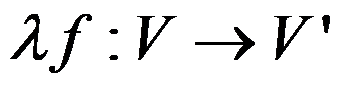 ,
is the product of with f.
,
is the product of with f.