Let n and p be two non-zero natural numbers. The number of sequences of p
elements belonging to a set of n elements is np.
Let E and F be two non-empty sets. If CardE=p and Card F=n, then the number of
functions defined on E with values in the set F is np.
Factorials
0!=1 (by definition).
1!=1
2!=1⋅2=2
3!=1⋅2⋅3=6
4!=1⋅2⋅3⋅4=24
......
n!= 1⋅2⋅3⋅...⋅n, n≥1
Properties: n!=(n−1)!n; n!=n+1(n+1)!
Permutations
Definition: A set together with a fixed order of its elements is an
ordered set, written (a1,a2,...,an).
Definition: The permutations of a set A with n elements are
all the ordered sets that can be formed from the n elements of n. The
number of permutations of n elements, n∈N∗, is Pn=1⋅2⋅3⋅...⋅n=n!;
Pn=n(n−1)!=nPn−1,(∀)n∈N∗ the recurrence formula
Arrangements
Definition: The arrangements of n elements taken m at a time (m≤n) of a
set A are all the ordered subsets of m elements that can be formed from
the n elements of the set A, taken n at a time. They are written
Ank.
The number of arrangements of n elements taken k at a time is:
Ank=n(n−1)...(n−k+1)=(n−k)!n!,n≥m; p,n∈N.
Properties:Ann=Pn, Ann=0!n! or Ann=n!;An0=1
Ank=(n−k+1)Ank−1 Ann=Ann−1;.
Combinations
Definition: The combinations of n elements taken k at a time (k≤n) of a
set A with n elements are all the subsets of k elements that can be
formed from the n elements of the set A. They are written Cnk.
Properties:
1) Cn1=n;Cnn=Cn0=C00=1; Cnk=k!(n−k)!n!;
2) Cnk=PpAnk n,k∈N, 0≤k≤n, Cnk∈N∗
3) The formula for complementary combinations: Cnk=Cnn−k;
4) The decomposition formula for combinations: Cnk=Cn−1k+Cn−1k−1;
n,k∈N, 0≤k≤n, Cnk∈N∗
Cnk=Cn−2k+2Cn−2k−1+Cn−2k−2
Cnk=Cn−3k+3Cn−3k−1+3Cn−3k−2+Cn−3k−3
5) The number of subsets of a set with n elements is 2n;
6) Cnm=Cn−1m−1+Cn−2m−1+...+Cm+1m−1+Cmm−1+Cm−1m−1;
e.g.: C73=C62+C52+C42+C32+C22;
7) p1!p2!...pk!n!=Cnp1⋅Cn−p1p2...Cn−(p1+...+pk−1)pk where p1+...+pk−1<n.
The binomial theorem
(x+a)n=Cn0xn+Cn1xn−1a+...+Cnkxn−kak+...+Cnnan=k=0∑nCnkxn−kak,
(x−a)n=Cn0xn−Cn1xn−1a+...+(−1)kCnkxn−kak+...+(−1)nCnnan where n∈N.
Properties:
1) The term of rank k+1 is Tk+1=(−1)kCnkxn−kak
2) Cnk+1=k+1n−kCn+1k+1;Cn+1k+1=k+1n−kCnk
3) Tk+2=k+1n−kxaTk+1 or Tk+2=−k+1n−kkaTk+1
4) The number of terms in the expansion (x±a)n is n+1
5) The coefficients of terms equally distant from the ends are equal.
6) Cn0,Cn1,...,Cnn are called binomial coefficients.
Important relations:
Cn0+Cn1+...+Cnn=2n; Cn0−Cn1+...+(−1)nCnn=0;
Cn0+Cn2+Cn4+...=2n−1; Cn1+Cn3+Cn5+...=2n−1;
C2nn=(Cn0)2+(Cn1)2+...+(Cnn)2
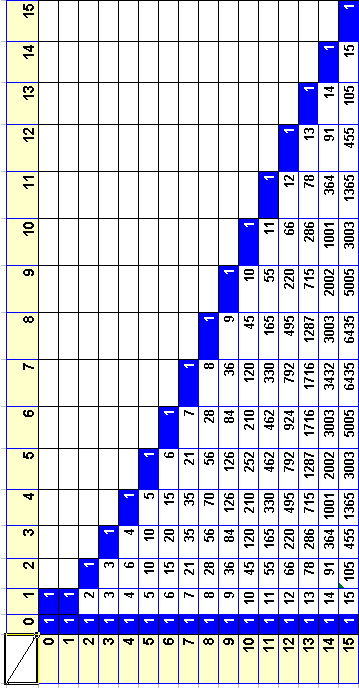
We arrange numbers in the table below, placing Cnk at the intersection of row
n with column k. Since k≤n, the table is filled in only below the
main diagonal, so its shape is triangular. This array is called "Pascal's
triangle" or the "arithmetic triangle".
Each number at the intersection of row n with column k is obtained by
adding the number directly above it, at the intersection of row n−1 with
column k, to the one to its left at the intersection of row n−1 with
column k−1.
| |
|---|
| Pascal's triangle (1665): | |
|
n
Common particular expansions:
1)(a±b)2=a2±2ab+b2;
2)(a+b+c)2=a2+b2+c2+2(ab+bc+ac);
3)(a+b)3=a3+3a2b+3ab2+b3;
4)(a−b)3=a3−3a2b+3ab2−b3
5)(a+b+c)3=a3+b3+c3+3(a2b+a2c+b2a+b2c+c2a+c2b)+6abc
6)(a+b)4=a4+4a3b+6a2b2+4ab3+b4
The sum of like powers of the first n natural numbers
If Sk=1k+2k+...+nk,k∈N, then we have:
S1=2n(n+1);S2=6n(n+1)(2n+1);S3=[2n(n+1)]2;
S4=30n(n+1)(6n3+9n2+n−1);S5=12n2(n+1)2(2n2+2n−1).
k=1∑n2k=n(n+1),n∈N k=1∑n(2k−1)=n2,n∈N
A relation that allows Sk to be computed once Sk−1,Sk−2,...,S1 are known is Pascal's
formula:
(n+1)p+1=1+Cp+11Sp+Cp+12Sp−1+...+Cp+1pS1+n