Definition. Let M={1,2,…,m} and N={1,2,…,n}. A map , A(i,j)=(aij)i=1,mj=1,n is
called a matrix of type (m,n); with m rows and n columns:
A=a11a12...a1na21a22...a2n............am1am2...amn and we write for the set of matrices of type (m,n) with complex
entries.
If then the matrix is called square of ordern, and the set of
such matrices is written Mn(C).
Operations with matrices:
Addition
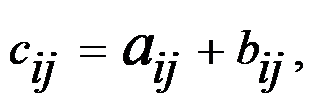
Let , then C=A+B∈Mm,n(C) where is their sum.
Properties, (∀)A,B,C∈Mm,n(C):
(commutativity);
(associativity);
A+O=O+A=A (the identity element is the zero matrix O);
A+(−A)=(−A)+A=O (the opposite of is ).
Multiplication by scalars
Let and , then B=λ⋅A∈Mm,n(C), where bij=λ⋅aij is the product of the
matrix A with the scalar .
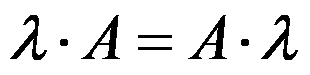
Properties, (∀)A,B∈Mm,n(C) and λ,μ∈C:
1⋅A=A;
;
λ⋅(A+B)=λ⋅A+λ⋅B;
;
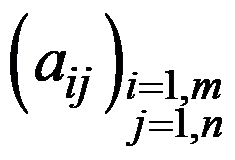
The transpose of a matrixA= with m rows and n columns
is a matrix written tA=(bij)i=1,nj=1,m with n rows and m columns, where
bij = aij, (∀)i=1,n,j=1,m.
Matrix multiplication
Let and B∈Mn,p(C), then , where cij=k=1∑naik⋅bkj, is their product.
Properties:
(A⋅B)⋅C=A⋅(B⋅C) (associativity);
A⋅In=In⋅A (identity element). The identity matrix In=10⋯001⋯0⋯⋯⋯00⋯1 in Mn(C);
(A+B)⋅C=A⋅C+B⋅C;
A⋅(B+C)=A⋅B+A⋅C.
Determinants
Let Mn(C) be the set of square matrices of order n with entries in C:
A=a11a12⋯a1na21a22⋯a2n⋯⋯⋯⋯an1an2⋯ann, A∈Mn(C).
The determinant of the order-2 matrix (a11a21a12a22) is
Δ=a11a21a12a22=a11a22– a12a21.
The determinant of the order-3 matrix A=a11a21a31a12a22a32a13a23a33 is the number
The rule of minors, or expanding the determinant along a row or column.
Choose a row or a column and multiply each entry aij of that row or
column by the lower-order determinant obtained by deleting row i and column
j, and by (-1)i+j; adding the resulting products gives the value
of the determinant. a11a21a31a12a22a32a13a23a33=(−1)1+1a11a22a32a23a33+(−1)1+2a12a21a31a23a33+(−1)1+3a13a21a31a22a32==−a21a12a32a13a33+a22a11a31a13a33−a23a11a31a12a32=...
Properties of determinants:
The determinant of a matrix equals the determinant of its transpose.
det(A)=det(tA)
A matrix with a row (or column) whose entries are all 0 has determinant 0.
If all entries of a row (or column) of a matrix are multiplied by a number,
the value of the determinant is multiplied by that number.
If to all entries of a row (respectively column) we add the corresponding
entries of another row (respectively column) multiplied by a number, the
value of the determinant does not change.
If a matrix has two proportional rows (respectively columns), then the
determinant is zero.
If two rows (or two columns) of a square matrix are interchanged, the value
of the determinant is multiplied by -1.
The determinant of the product of two matrices of the same order equals the
product of the determinants of those matrices.
det(A⋅B)=det(A)⋅det(B)
If a row (respectively column) of the determinant of a matrix is a linear
combination of the other rows (respectively columns), that determinant is
zero.
The value Δ of the determinant of the matrix associated with a system
determines whether the system is consistent: if Δ≠0, the system is
consistent with a unique solution; if Δ=0, then the system may be
inconsistent or consistent and indeterminate.
Linear systems
We write aij for the coefficients, xi for the unknowns, bi for the
constant terms, m for the number of equations, n for the number of
unknowns, r for the rank of the matrix A or the rank of the system, and A
for the augmented matrix.
A system is consistent with a unique solution if:
r=m=n and detA=Δ=0;
r=n<mrangA=r.
A system is consistent and indeterminate if:
r=m<n;
r<min(m,n) andrangA=rangA=r.
A system is inconsistent if r≤min(m,n) and rangA=r+1.
Cramer's method.
Let S be a linear system with unknowns xi and Δ its
determinant. Suppose Δ≠0 and r=m=n. Write Δxi for the determinant
obtained from Δ by replacing the column of coefficients of the unknown
xi with the column of constant terms.
The solution of the linear system {a11x1+a12x2=b1a21x1+a22x2=b2 is x1 =ΔΔx1 and
x2=ΔΔx2.
The solution of the linear system ⎩⎨⎧a11x1+a12x2+a13x3=b1a12x1+a22x2+a23x3=b2a13x1+a23x2+a33x3=b3 is x1=ΔΔx1,
x2=ΔΔx2 and x3=ΔΔx3.
The solution of the system ⎩⎨⎧a11x1+a12x2+a13x3+a14x4=b1a12x1+a22x2+a23x3+a24x4=b2a13x1+a23x2+a33x3+a34x4=b3a14x1+a24x2+a34x3+a44x4=b4 is x1=ΔΔx1,
x2=ΔΔx2, x3=ΔΔx3 and x4=ΔΔx4.
A homogeneous linear system has all determinants Δxi zero; it therefore always
admits at least the zero solution
(x1,x2,x3)=(0,0,0). Such a system also
admits non-zero solutions if Δ=0.
Systems of homogeneous equations
Such a system has the form:
{a1x2+b1xy+c1y2=d1a2x2+b2xy+c2y2=d2
Suppose d1=0 i d2=0; in this case we multiply the first equation and add it to the
second so as to obtain an equivalent system of the form:
{a1x2+b1xy+c1y2=d1a3x2+b3xy+c3y2=0
Since d1=0 the system does not have the solution x=0 and y=0. We divide
the second equation by x2 and obtain the second-degree equation in xy:
a3+b3xy+c3(xy)2=0 which, by the substitution xy=t, gives: c3t2+b3t+a3=0. Solving this
equation generally gives two values t1 i t2, that is xy=t1 and xy=t2.
Solving the original system is equivalent to solving the following two systems:
{y=t1xa1x2+b1xy+c1y2=d1 and {y=t2xa1x2+b1xy+c1y2=d1
Systems of symmetric equations
An equation in two unknowns is called symmetric if replacing x by y
and y by x leaves the equation unchanged.
{xy+x+y=39x2−xy+y2=63
Systems of symmetric equations are solved as follows: introduce the auxiliary
unknowns s and p given by the relations s=x+y and p=x⋅y.
By introducing these new unknowns s and p, in very many cases the
original system reduces to a system consisting of one first-degree equation and
one second-degree equation in the unknowns s and p.
Once the unknowns s and p have been found, one forms the equation
t2−s⋅t+p=0
Since the system considered is symmetric in x and y, the solution set
of the system is:
S={(t1,t2);(t2,t1)} if t1=t2, or S={(t1,t2)} if t1=t2.
The inverse of a matrix
Let A∈Mn(C) be a square matrix of order n with coefficients in C. The
matrix A is invertible if and only if detA≠0. The inverse of the matrix A
is A-1=detA1A∗, where A* is obtained by replacing
each entry of the transposed matrix tA with its cofactor δij=(−1)i+jdij, 1*≤i≤n,*
1*≤j≤m*, where dij is the minor of the entry aij of tA (the
determinant obtained from tA by deleting row i and column j).
A⋅A−1=In,In∈Mn(C),In - the identity matrix.
Matrix equations
A linear system can be expressed in matrix form as: AX=B, where A is the
matrix of coefficients of the unknowns, X is the matrix of unknowns (a column
matrix) and B is the matrix of constant terms (a column matrix). If the matrix
is invertible we have
X=A-1B.
If the matrix A∈Mm,n(C) is not zero, there is a natural number
r≤min{m,n} such that at least one minor of order r (formed at the
intersection of r rows and r columns of the matrix) is non-zero, while all
determinants of order greater than r (if any) are zero. This number r is
called the rank of the matrix.
The rank of a matrix is unchanged if:
A multiple of one row (column) is added to another row (column);
Rows (columns) are interchanged.
The Kronecker–Capelli theorem. A system of linear equations is consistent if
and only if the rank of the system matrix equals the rank of the augmented
matrix, formed from the system matrix with the column of constant terms added.
Rouché's theorem. A system of linear equations is consistent if and only if all
the characteristic determinants are zero. The characteristic determinants are
obtained by adding a row and a column from the augmented matrix to a minor with
non-zero determinant.
The matrix of rotations in the plane.
Let θ∈[0,2π). The rotation with centre O through an angle of measure θ is
the geometric transformation Rθ:P→P,Rθ(0)=0, and Rθ(M)=M′, (∀)M∈P with the property that
OM=OM′ and the measure of the angle MOM′⌢ is θ.
The analytic description of the rotation is given by the relations:
{x′=xcos(θ)−ysin(θ)y′=xsin(θ)+ycos(θ).
With these, the rotation Rθ is the function Rθ:R2→R2, Rθ((x,y))=(x′,y′) where x′,y′
are given by the relations above. The matrix associated with the linear map
Rθ is:
 , is
called a matrix of type with m rows and n columns:
, is
called a matrix of type with m rows and n columns: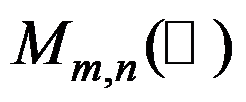 for the set of matrices of type with complex
entries.
for the set of matrices of type with complex
entries.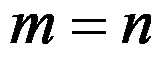 then the matrix is called square of order , and the set of
such matrices is written .
then the matrix is called square of order , and the set of
such matrices is written ., then where
is their sum.
 (commutativity);
 (associativity);
 is
is 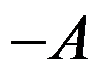 ).
).and
, then , where
.
 ;
; ;
; with m rows and n columns
is a matrix written with n rows and m columns, where
bij = aij,
with m rows and n columns
is a matrix written with n rows and m columns, where
bij = aij,  , where ,