Linear functions
Let be a function defined by the relation with a, b.
The function is increasing if a>0, and strictly increasing if a<0.
The function is constant if a=0.
If: 1) ; is the unique root. .
2) a=0 and , the function has no roots. .
3) a=0 and b=0, then every real number x is a root of the affine function .
The graph of a first-degree (affine) function
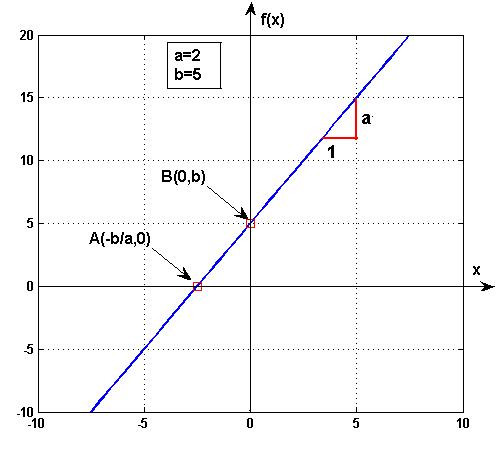
Sign of the affine function , ()
| Opposite sign to a | 0 | Same sign as a |
In the relation a is called the gradient of the line, and b is the y-intercept.
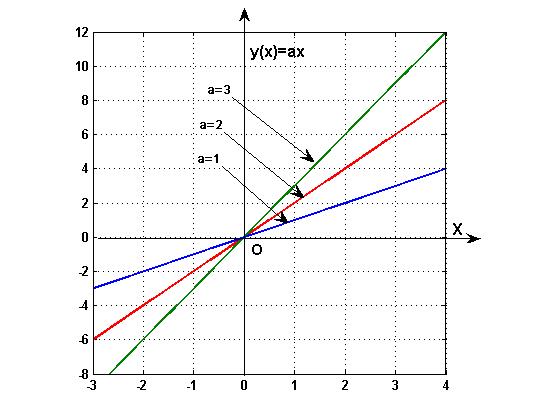
The significance of the gradient (a) can be seen in the figure below:
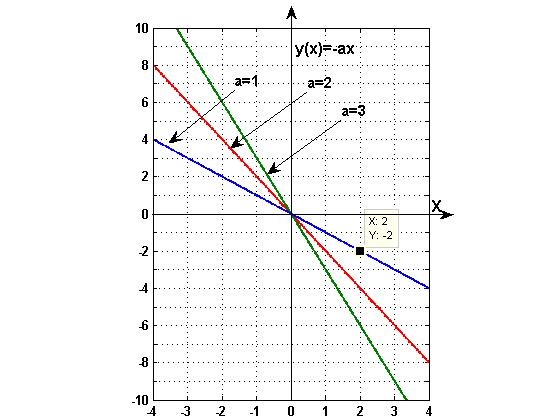
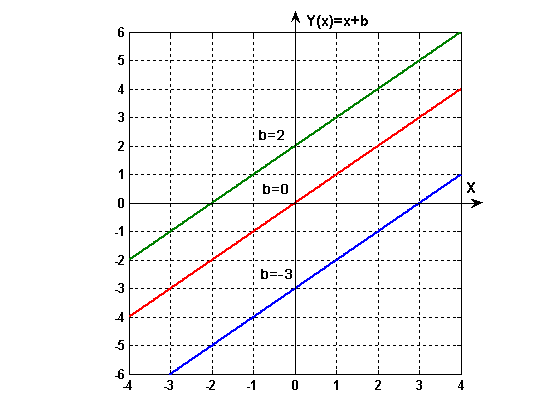
Particular cases of lines
-
The line parallel to the axis has the equation ;
-
The line parallel to the axis has the equation ;
-
The line with equation is called the first bisector;
-
The line with equation is called the second bisector.
A function with equation separates the plane into two disjoint half-planes (with no point in common):
1) the half-plane above the line d, made up of the points with the property ;
2) the half-plane below the line d, made up of the points with the property .
The relative position of two lines and in a coordinate system
Let and be two lines with equations ,
- Parallel lines. They have the same gradient (). The two lines do not intersect, so the system formed by them is inconsistent.
- Intersecting lines. The two lines and form a consistent system with a unique solution S. The geometric image of S is the point where the two lines meet.
Intersecting lines are perpendicular if .
- Coincident lines. The equations of the two lines and are identical (same gradient and same y-intercept). In this case the system formed by the two lines is consistent and indeterminate.
Try it
Drag the sliders. a is the gradient — how steeply the line climbs — and b is where it crosses the vertical axis.
Watch what happens when a is negative, and what happens when a is exactly 0.