Definition: Let a ∈ R + ∗ , a ≠ 1 a\in R_{+}^{*},\, a\ne 1 a ∈ R + ∗ , a = 1 b ∈ R + ∗ b\in R_{+}^{*} b ∈ R + ∗ logarithm b is the exponent to which the number a ,
called the base, must be raised in order to obtain the number b .
The logarithm of b to base a is written log a b {{\log }_{a}}b log a b a ∈ R + ∗ , a ≠ 1 a\in R_{+}^{*},\,a\ne 1 a ∈ R + ∗ , a = 1 b ∈ R + ∗ b\in R_{+}^{*} b ∈ R + ∗
log a b = x ⇔ a x = b {{\log }_{a}}b=x\Leftrightarrow {{a}^{x}}=b log a b = x ⇔ a x = b b = a log a b b={{a}^{{{\log }_{a}}b}} b = a l o g a b
For a = 10 a=10 a = 10 a = e a=e a = e
e a ln x = x a ⇒ e ln x = x {{e}^{a\ln x}}={{x}^{a}}\Rightarrow {{e}^{\ln x}}=x e a l n x = x a ⇒ e l n x = x
lg10=1 lne=1 lg100=lg(102 )=2 ln(e2 )=2 lg1000=lg(103 )=3 ln(e3 )=3 lg(10n )=n ln(en )=n
Properties:
1)log a b = log a c ⇔ b = c , ( b , c > 0 ) ; {{\log }_{a}}b={{\log }_{a}}c\Leftrightarrow b=c,\left( b,c>0 \right); log a b = log a c ⇔ b = c , ( b , c > 0 ) ;
2)log a a = 1 ; {{\log }_{a}}a=1; log a a = 1 ;
3)log a 1 = log a a 0 = 0 ; {{\log }_{a}}1={{\log }_{a}}{{a}^{0}}=0; log a 1 = log a a 0 = 0 ;
4)log a a c = c ; log a 1 b = − log a b ; {{\log }_{a}}{{a}^{c}}=c\,;\,{{\log }_{a}}\frac{1}{b}=-{{\log }_{a}}b;\, log a a c = c ; log a b 1 = − log a b ; log a x 2 n = 2 n log a ∣ x ∣ , x ≠ 0 ; {{\log }_{a}}{{x}^{2n}}=2n{{\log }_{a}}\left| x \right|\,,x\ne 0; log a x 2 n = 2 n log a ∣ x ∣ , x = 0 ;
5)log a b m = 1 m log a b , ( b > 0 , m ∈ N , m ≥ 2 ) ; {{\log }_{a}}\sqrt[m]{b}=\frac{1}{m}{{\log }_{a}}b,\,\left( b>0,m\in N,m\ge 2 \right)\,; log a m b = m 1 log a b , ( b > 0 , m ∈ N , m ≥ 2 ) ;
6)log a b ⋅ log b a = 1 ; {{\log }_{a}}b\cdot {{\log }_{b}}a=1; log a b ⋅ log b a = 1 ;
Change of base formula: log a b = log c b log c a ; {{\log }_{a}}b=\frac{{{\log }_{c}}b}{{{\log }_{c}}a}\,; log a b = l o g c a l o g c b ;
8)x > 0 x>0 x > 0 y > 0 ⇒ log a x y = log a x + log a y ; y>0\,\Rightarrow {{\log }_{a}}xy={{\log }_{a}}x+{{\log }_{a}}y\,; y > 0 ⇒ log a x y = log a x + log a y ;
9)x > 0 x>0 x > 0 y > 0 ⇒ log a x y = log a x − log a y ; y>0\,\Rightarrow {{\log }_{a}}\frac{x}{y}={{\log }_{a}}x-{{\log }_{a}}y\,; y > 0 ⇒ log a y x = log a x − log a y ;
13)x > 0 , y > 0 , a > 0 , b > 0 , a ≠ 1 , b ≠ 1 ⇒ log a x log a y = log b x log b y ; x>0,y>0,a>0,b>0,a\ne 1,b\ne 1\,\Rightarrow \frac{{{\log }_{a}}x}{{{\log }_{a}}y}=\frac{{{\log }_{b}}x}{{{\log }_{b}}y}; x > 0 , y > 0 , a > 0 , b > 0 , a = 1 , b = 1 ⇒ l o g a y l o g a x = l o g b y l o g b x ;
14)x > 0 , a > 0 , a ≠ 1 , n ∈ N ⇒ log a x = log a n x n ; x>0,a>0,a\ne 1,n\in N\,\Rightarrow {{\log }_{a}}x={{\log }_{{{a}^{n}}}}{{x}^{n}}; x > 0 , a > 0 , a = 1 , n ∈ N ⇒ log a x = log a n x n ;
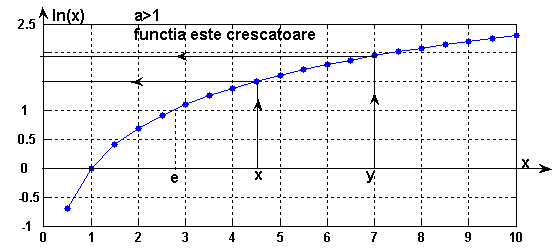
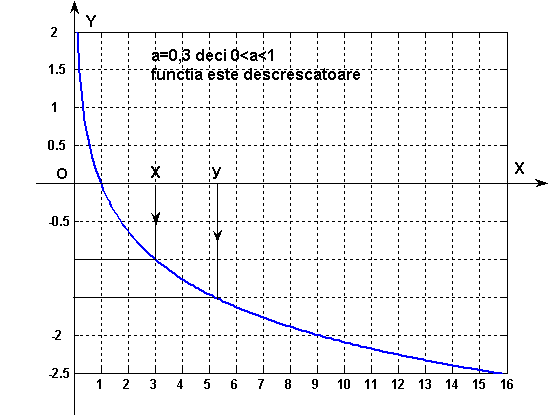
a > 1 a>1 a > 1 x ∈ ( 0 , 1 ) x\in \left( 0,1 \right) x ∈ ( 0 , 1 ) log a x < 0 {{\log }_{a}}x<0 log a x < 0 a > 1 a>1 a > 1 x > 1 x>1 x > 1 log a x > 0 {{\log }_{a}}x>0 log a x > 0 0 < a < 1 0<a<1 0 < a < 1 x ∈ ( 0 , 1 ) x\in \left( 0,1 \right) x ∈ ( 0 , 1 ) log a x > 0 {{\log }_{a}}x>0 log a x > 0 0 < a < 1 0<a<1 0 < a < 1 x > 1 x>1 x > 1 log a x < 0 {{\log }_{a}}x<0 log a x < 0
15)
a > 1 a>1 a > 1 0 < x < y 0<x<y 0 < x < y log a x < log a y {{\log }_{a}}x<{{\log }_{a}}y log a x < log a y The function is strictly increasing 0 < a < 1 0<a<1 0 < a < 1 0 < x < y 0<x<y 0 < x < y log a x > log a y {{\log }_{a}}x>{{\log }_{a}}y log a x > log a y The function is strictly decreasing
16)x ∈ R , a > 0. a ≠ 1 ⇒ a x = e x ln a x\in R,a>0.a\ne 1\,\Rightarrow {{a}^{x}}={{e}^{x\ln a}} x ∈ R , a > 0. a = 1 ⇒ a x = e x l n a
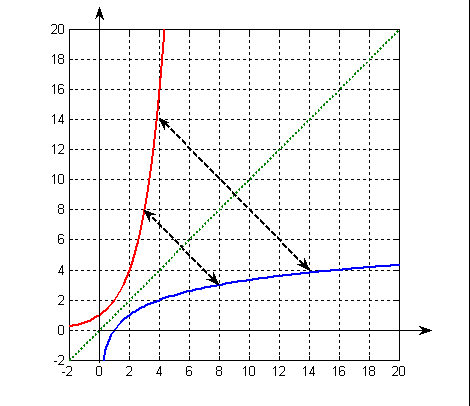
17) The logarithmic function is invertible and its inverse is the exponential
function f ( x ) = log a x , f(x)={{\log }_{a}}x, f ( x ) = log a x , f − 1 ( x ) = a x , {{f}^{-1}}(x)={{a}^{x}}, f − 1 ( x ) = a x , g ( x ) = x . g(x)=x. g ( x ) = x .
Limits involving logarithms
lim x → ∞ l o g a x x α = 0 \displaystyle \underset{x\to \infty }{\mathop{\lim }}\,\frac{lo{{g}_{a}}x}{{{x}^{\alpha }}}=0 x → ∞ lim x α l o g a x = 0 lim x → ∞ a x x α = ∞ \displaystyle \underset{x\to \infty }{\mathop{\lim }}\,\frac{{{a}^{x}}}{{{x}^{\alpha }}}=\infty x → ∞ lim x α a x = ∞ lim x → ∞ l o g a x a x = 0 \displaystyle \underset{x\to \infty }{\mathop{\lim }}\,\frac{lo{{g}_{a}}x}{{{a}^{x}}}=0 x → ∞ lim a x l o g a x = 0 lim x → ∞ a x l o g a x = ∞ \displaystyle \underset{x\to \infty }{\mathop{\lim }}\,\frac{{{a}^{x}}}{lo{{g}_{a}}x}=\infty x → ∞ lim l o g a x a x = ∞ lim x → ∞ x α a x = 0 \displaystyle \underset{x\to \infty }{\mathop{\lim }}\,\frac{{{x}^{\alpha }}}{{{a}^{x}}}=0 x → ∞ lim a x x α = 0 lim x → ∞ x α l o g a x = ∞ \displaystyle \underset{x\to \infty }{\mathop{\lim }}\,\frac{{{x}^{\alpha }}}{lo{{g}_{a}}x}=\infty x → ∞ lim l o g a x x α = ∞
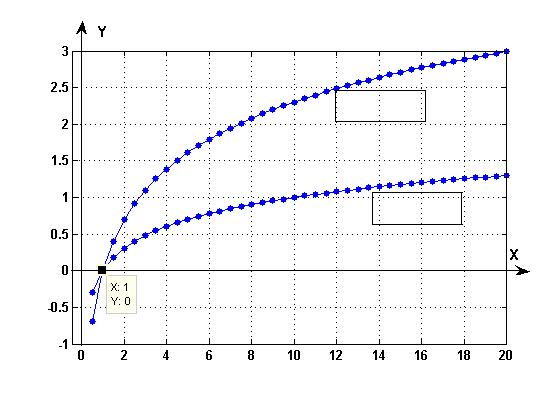
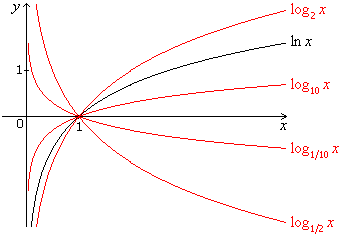
These limits can also be read off the graphs above.
For a>1 For 0<a<1 lim x → ∞ ( log a x ) = ∞ \displaystyle \underset{x\to \infty }{\mathop{\lim }}\,({{\log }_{a}}x)=\infty x → ∞ lim ( log a x ) = ∞ lim x → ∞ ( log a x ) = − ∞ \displaystyle \underset{x\to \infty }{\mathop{\lim }}\,({{\log }_{a}}x)=-\infty x → ∞ lim ( log a x ) = − ∞ lim x → 0 x > 0 ( log a x ) = − ∞ \displaystyle \underset{\underset{x>0}{\mathop{x\to 0}}\,}{\mathop{\lim }}\,({{\log }_{a}}x)=-\infty x > 0 x → 0 lim ( log a x ) = − ∞ lim x → 0 x > 0 ( log a x ) = ∞ \displaystyle \underset{\underset{x>0}{\mathop{x\to 0}}\,}{\mathop{\lim }}\,({{\log }_{a}}x)=\infty x > 0 x → 0 lim ( log a x ) = ∞