Geometric transformations of graphs
Translating graphs along the coordinate axes. Suppose the function and the numbers . Then:
-
the graph of the function is obtained by translating the graph of by units to the right;
-
the graph of the function is obtained by translating the graph of by units to the right;
-
the graph of the function or is obtained by translating the graph of by units in the positive direction of the axis (upwards);
-
the graph of the function or is obtained by translating the graph of by units in the negative direction of the axis (downwards).
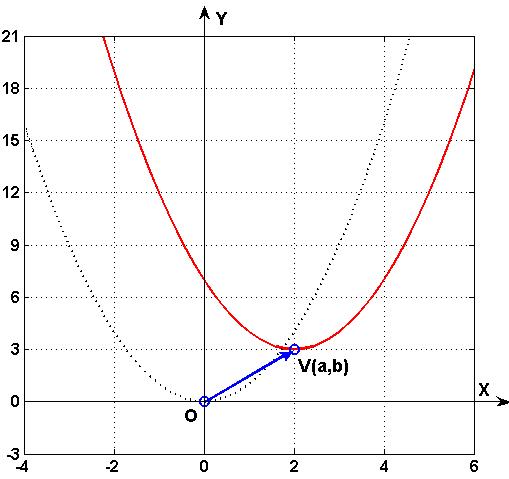
The graph of is obtained from the graph of by two translations.
Compressing and stretching graphs. Suppose the function and the number . Then:
- the graph of the function is obtained by compressing the graph of horizontally by a factor of ;
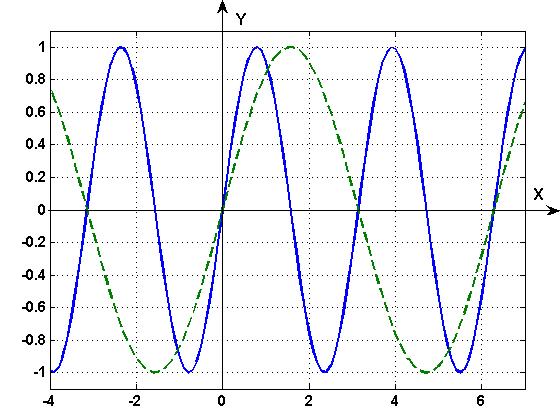
The graph of is obtained from the graph of by a contraction along the x-axis.
-
the graph of the function is obtained by stretching the graph of horizontally by a factor of ;
-
the graph of the function is obtained by stretching the graph of vertically by a factor of ;
The graphs of the functions and
The graph of the function for the following values of a = 1, 2, 3.
- the graph of the function is obtained by compressing the graph of vertically by a factor of ;
Reflecting graphs in the coordinate axes. Suppose the function . Then:
-
the graph of the function is obtained by reflecting the graph of in the axis;
-
the graph of the function is obtained by reflecting the graph of in the axis.
In physics one meets the function:
The fundamental period of the function is
The graph of the function for
Try it
Every transformation in this chapter, on one curve.
A stretches it vertically (the amplitude), ω squeezes it horizontally (the angular frequency), φ slides it sideways (the phase), and d lifts it. This is the physics function from the end of the chapter, made movable.
Notice that changing φ alone moves the curve left or right without changing its shape — a translation along Ox. Changing d alone moves it up or down. Those are the first two rules of the chapter, and you can see them separately.
Take a through zero: the parabola flattens, then opens the other way. That is the reflection in the Ox axis the chapter describes.