Definition: Let A and B be two sets. By a function defined on the
setA, with values inB we mean any rule (procedure or convention)
f which associates to every element a∈A a single element, written f(a),
in B. The set A is called the domain, and the set B is called the
codomain of the function, or the set of values of the function.
Let f:A→B be a function. By the graph of this function we mean the subset
Gf of the Cartesian product A×B formed from the pairs (a,f(a)),a∈A. So
Gf={(a,f(a))∣a∈A}.
Definition: A numerical function is a function f:A→B for which both
the domain A and the set of values B are subsets of the set of real
numbers.
Definition: Let f:A→B be a function. We say f is an injective
function (one-to-one) if for any two elements x i y of A, x=y, we
have f(x)=f(y). The fact that f is injective can also be written:
(∀)x,y∈A;f(x)=f(y)⇒x=y.
Let y=m,m∈R be a family of lines parallel to the Ox axis. If these lines meet
the graph of the function f in at most one point (one or none), then
f is injective.
Definition: Let f:A→B be a function. We say f is a surjective
function (onto) if for every b∈B there is at least one element a∈A
such that f(a)=b. So f:A→B is not surjective if ∃b∈B we have f(a)=b, (∀)a∈A.
Let y=m,m∈R be a family of lines parallel to the Ox axis. If these lines meet
the graph of the function f in at least one point, then f is
surjective.
Definition: A function f:A→B which is both injective and surjective is called a
bijective function.
Let y=m,m∈R be a family of lines parallel to the Ox axis. If these lines meet
the graph of the function f in exactly one point, then f is
bijective.
Every continuous, strictly monotonic function is bijective.
Definition: Let the functions be f:A→B and g:B→C (the codomain of f
coincides with the domain of g). Let a∈A; then f(a)∈B, so its image
under g exists, namely g(f(a))∈C. We can therefore define a function h:A→C
where h(a)=g(f(a)) for (∀)a∈A. The function h defined this way is written
g∘f and is called the composition of the functiongwith the
functionf.
If f:A→B and g:C→D are two functions, it only makes sense to speak of the
composition of g with f when B=C.
If f:A→B and g:B→A are two functions, both g∘f:A→A and f∘g:B→B make sense.
In general f∘g=g∘f.
Let f:A→B, g:B→C and h:C→D be three functions. Then each of the functions
h∘(g∘f), (h∘g)∘f makes sense, and the following equality holds: h∘(g∘f)=(h∘g)∘f.
If f:R→R is a linear function, f(x)=ax+b,a=0, then there is a function g:R→R,
g(x)=a1x−ab,a=0, such that f∘g=g∘f=x:
g∘f=(g∘f)(x)=a1(ax+b)−ab=x,∀x∈R
f∘g=(f∘g)(x)=a(a1x−ab)+b=x,∀x∈R
So the function f(x)=ax+b is invertible.
Let f:[0,∞)→[0,∞), f(x)=x2 and f−1:[0,∞)→[0,∞), f−1(x)=x
(f∘f−1)(x)=f(f−1(x))=f(x)=(x)2=x,∀x≥0
(f−1∘f)(x)=f−1(f(x))=f−1(x2)=x2=∣x∣=x,∀x>0
Let f:(0,∞)→(0,∞), f(x)=x1 have f−1(x)=x1, so: f−1(x)=f(x),∀x∈(0,+∞)
Let sin:[−2π,2π]→[−1,1], a bijective function on this domain with inverse arcsin:[−1,1]→[−2π,2π]. The
graphs of these functions are shown in the figure below, so that the
symmetry about the line y = x can be seen.
Let cos:[0,π]→[−1,1], a bijective function on this domain with inverse arccos:[−1,1]→[0,π]. The
graphs of these functions are shown in the adjacent figure, so that the
symmetry about the line y = x can be seen.
Translating graphs along the coordinate axes. Suppose the function y=f(x)
and the numbers a,b>0. Then:
the graph of the function y=f(x−a) is obtained by translating the graph of
y=f(x) by a units to the right;
the graph of the function y=f(x+a) is obtained by translating the graph of
y=f(x) by a units to the right;
the graph of the function y−b=f(x) or y=f(x)+b is obtained by translating the
graph of y=f(x) by b units in the positive direction of the Oy
axis (upwards);
the graph of the function y+b=f(x) or y=f(x)−b is obtained by translating the
graph of y=f(x) by b units in the negative direction of the Oy
axis (downwards).
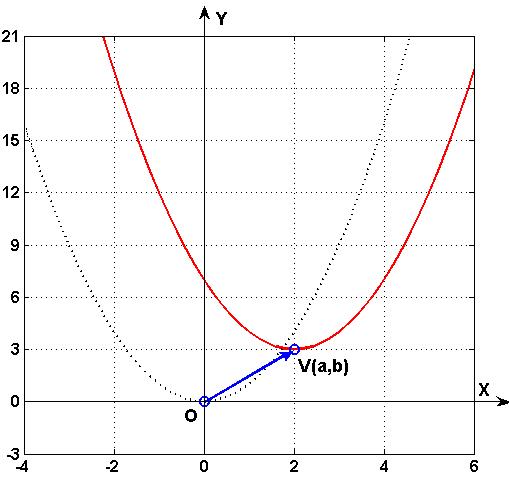
The graph of y−3=(x−2)2 is obtained from the graph of y=x2 by two
translations.
Compressing and stretching graphs. Suppose the function y=f(x) and the
number a>1. Then:
the graph of the function y=f(ax) is obtained by compressing the graph of
y=f(x) horizontally by a factor of a;
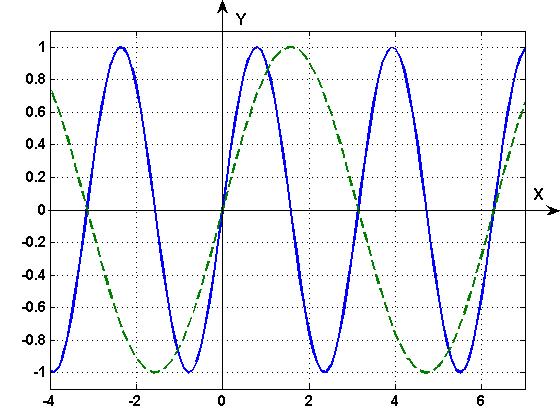
The graph of g(x)=sin(2⋅x) is obtained from the graph of f(x)=sin(x) by a contraction
along the x-axis.
the graph of the function y=f(ax) is obtained by stretching the graph of
y=f(x) horizontally by a factor of a;
the graph of the function y=af(x) is obtained by stretching the graph of
y=f(x) vertically by a factor of a;
The graphs of the functions f(x)=sin(x) and g(x)=3⋅sin(x)
The graph of the function f(x)=ax2 for the following values of a = 1, 2, 3.
the graph of the function y=af(x) is obtained by compressing the graph of
y=f(x) vertically by a factor of a;
Reflecting graphs in the coordinate axes. Suppose the function y=f(x).
Then:
the graph of the function y=f(−x) is obtained by reflecting the graph of
y=f(x) in the Oy axis;
the graph of the function y=−f(x) is obtained by reflecting the graph of
y=f(x) in the Ox axis.
In physics one meets the function: f:R→R,f(x)=A⋅cos(ωx+b),ω=0
A=amplitudine,ω=pulsatie,b=fazainiiala˘. The fundamental period of the function is T=∣ω∣2π.
The graph of the function f(x)=sin(x−b) for b=0,4π,π,23π