Arithmetic progressions
Definition: An arithmetic progression is a sequence of numbers a1,a2,a3,...,an,... in which
each term, starting from 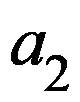 , is obtained from the previous one by adding a
constant number called the common difference of the progression. It is written
⋅−˙a1,a2,a3,...,an,...
, is obtained from the previous one by adding a
constant number called the common difference of the progression. It is written
⋅−˙a1,a2,a3,...,an,...
If a1 is the first term,  the n-th term (the general term), r
the common difference, n the number of terms and
the n-th term (the general term), r
the common difference, n the number of terms and  the sum of the n
terms, then we have:
the sum of the n
terms, then we have:
an=an−1+r,n≥2 (by definition)
an=a1+(n−1)r,n≥2
r=an−an−1,n≥2
Sn=a1+a2+a3+...+an, Sn=n(a1+an)⋅n, 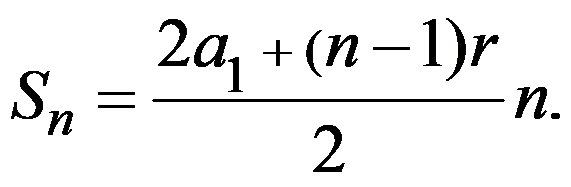
Terms equidistant from the ends
In an arithmetic progression the sum of two terms equidistant from the ends is
equal to the sum of the end terms:  .
.
If the number of terms is odd, then there is a middle term am+1, such that
2am+1=a1+a2m+1.
The necessary and sufficient condition for three terms a,b,c,, taken in that
order, to form an arithmetic progression is that 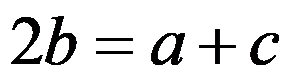 .
.
k=1∑n2k=n(n+1),n∈N k=1∑n(2k−1)=n2,n∈N
Geometric progressions
Definition: A geometric progression is a sequence of numbers a1,a2,a3,...,an,... in which
each term, starting from , is obtained from the previous one by
multiplying it by one and the same 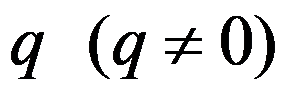 , called the common ratio. It is
written ..−..a1,a2,a3,...,an,...
, called the common ratio. It is
written ..−..a1,a2,a3,...,an,...
If a1 is the first term, the n-th term (the general term),
q the common ratio, n the number of terms and the sum of the
n terms, then we have:
an=q⋅an−1,n≥2 (by definition)
an=a1⋅qn−1,n≥2, q=an−1an
Sn=a1+a2+a3+...+an, Sn=a1q−1qn−1, 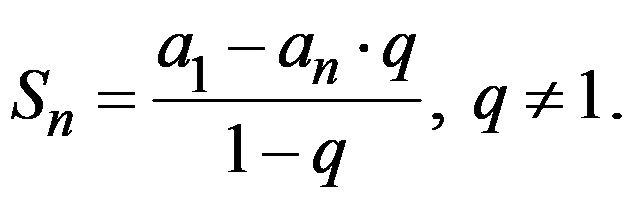
Sn=n⋅a1, dac a˘ q=1
Terms equidistant from the ends
In a geometric progression the product of two terms equidistant from the ends is
equal to the product of the end terms: ak⋅an−k+1=a1⋅an.
If the number of terms is odd, then there is a middle term am+1, such that
a2m+1=a1⋅a2m+1.
The necessary and sufficient condition for three terms a,b,c,, taken in that
order, to form a geometric progression is that b2=a⋅c.
Note. If the geometric progression is decreasing (∣q∣<1) and the number of
terms is infinite, then
S∞=q−1a1.